一页概览
本节导读:先看 U0 统一了什么任务,以及它如何把生成模型变成机器人数据引擎。
Xiaomi-Robotics-U0:基于 World Foundation Model 的统一具身合成
Xiaomi-Robotics-U0: Unified Embodied Synthesis with World Foundation Model
一句话抓住论文
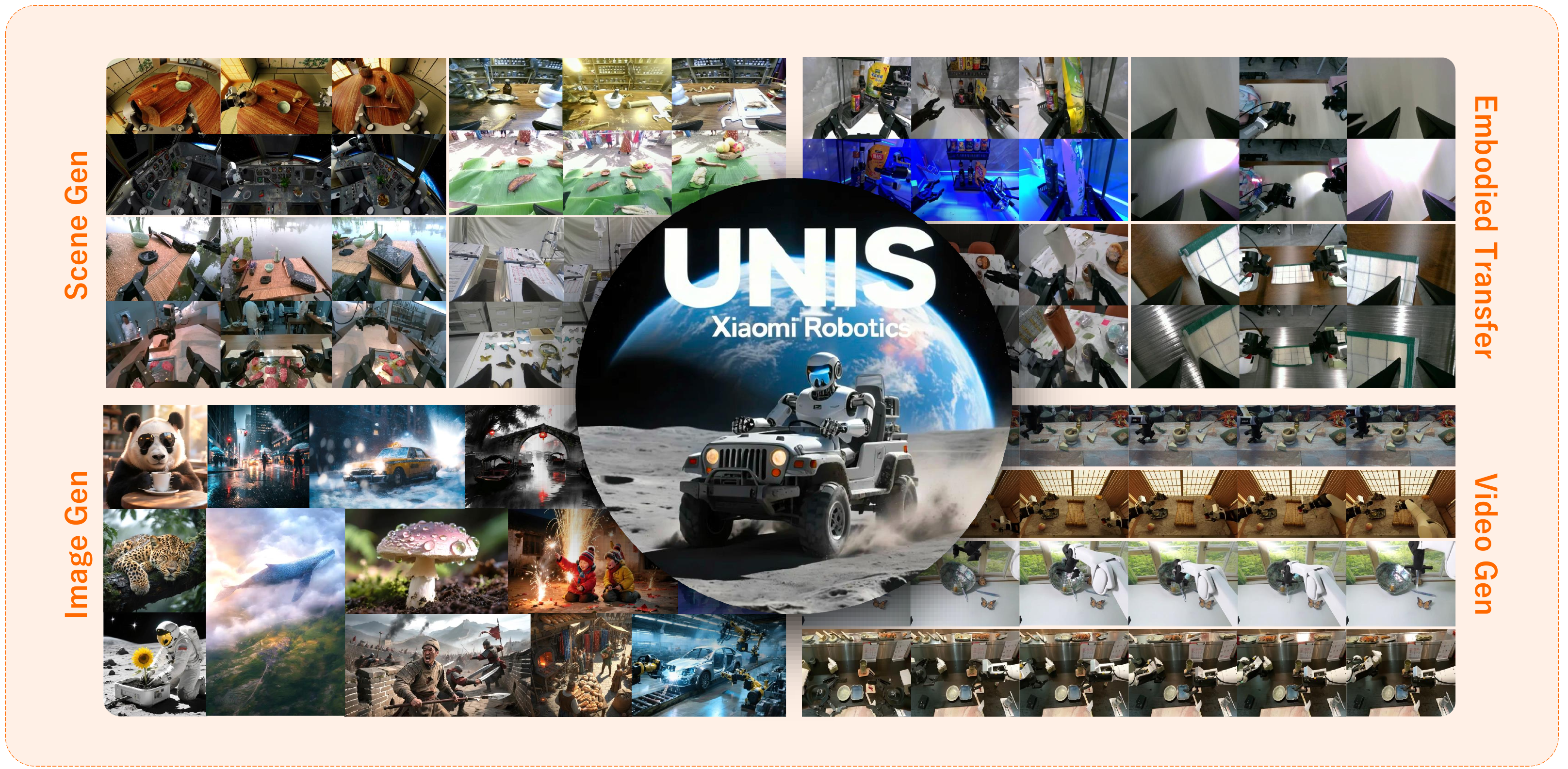
Xiaomi-Robotics-U0 以一个 38B multimodal autoregressive model 统一学习文本到图像、图像编辑、多视角机器人场景生成、具身迁移和具身视频生成,并用生成的场景和视频扩充机器人策略训练数据。核心价值是同时保留大规模预训练获得的通用视觉能力,以及具身任务所需的几何一致性、机器人约束和交互动力学。
摘要与研究定位
本节导读:论文的核心问题是如何适配 embodied constraints,同时不牺牲 foundation model 的通用视觉知识。
近期 foundation image 和 video generation models 展现了很强的泛化与可控性,但直接应用到 embodied scenarios 时,会受到 multi-view consistency、几何一致性和 robot embodiment constraints 的限制。现有方法通常用规模有限的机器人数据适配 foundation model,容易牺牲大规模预训练获得的视觉知识。
本文提出 Xiaomi-Robotics-U0,一个 380 亿参数的 multimodal autoregressive model,用于统一 embodied synthesis。它把具身生成视为 foundation image/video generation 的延伸,并联合优化 text-to-image generation、image editing、embodied scene generation、embodied transfer 和 embodied video generation。统一框架在适应具身场景的同时,保留预训练 world foundation model 的泛化能力。
Xiaomi-Robotics-U0 支持跨多种 robot embodiment 的高质量 multi-view scene generation,并引入结构化、可控的 embodied transfer,在保持多视角一致性和交互动力学的同时实现细粒度编辑。实验在 single-step 和 sequential generation tasks 上达到 state-of-the-art;在 embodied scene generation 和 transfer 的人工评测中超过 GPT-Image-2.0,在 World Arena 的 embodied video generation 中排名第一,并将 pi_0.5 在困难真实操作任务上的 out-of-distribution success rate 从 36.9% 提高到 63.2%。
这些结果表明,foundation world model 既可以作为 embodied world model,也可以作为 embodied intelligence 的可扩展数据引擎。论文给出的代码与 checkpoint 页面为 robotics.xiaomi.com/xiaomi-robotics-u0.html。
引言
本节导读:理解 embodied generation 与普通图像/视频生成的差异,再看统一框架的动机。
Foundation image 和 video generation models 通过 Internet-scale data 的训练,在 semantic understanding、controllable generation 和 visual reasoning 方面取得巨大进展。它们可以根据多模态输入合成逼真的图像和视频,泛化到远离训练分布的内容,因此成为 embodied intelligence 的有吸引力的起点:机器人需要在执行动作前理解复杂环境并想象未来交互。
但具身生成与普通图像、视频 synthesis 有根本区别。具身场景要求多摄像机之间严格一致,保持跨视角的几何和物理 coherence,满足明确的 robot embodiment constraints,并维持时间一致的 interaction dynamics。生成的 observation 不仅要看起来逼真,还必须与机器人运动学、camera calibration 和下游 manipulation policy 兼容。直接套用通用 foundation model,往往会出现几何冲突、不合理的机器人状态以及与控制系统不兼容的问题。
近期 embodied world models 通过机器人轨迹或 egocentric manipulation videos 适配预训练 foundation model。它们推进了具身预测,但适配通常只使用 robot-specific datasets;这些数据相较 Internet-scale visual corpus 更小、更单一、更重复,因而会削弱 foundation model 原有的泛化、可控性和生成多样性。
本文提出 Xiaomi-Robotics-U0,把 foundation generation 和 embodied generation 放进同一个 continual training paradigm。模型同时使用 general-domain 和 embodied datasets,在统一 autoregressive objective 下学习 T2I、image editing、embodied scene generation、embodied transfer 和 embodied video generation。这样,模型可以保留丰富的 semantic knowledge 与 controllable generation,同时学习机器人中心的 multi-view reasoning 和 interaction modeling。
模型还把 embodied synthesis 从静态场景扩展到 sequential world modeling:通过 interleaved embodied sequences 和多时间分辨率的 manipulation videos,同时捕获长时域任务进展与细粒度交互动力学。更重要的是,生成的 embodied scene 可以继续 rollout 成时间连贯的 manipulation video,成为下游 policy learning 的可扩展 synthetic trajectory engine。
论文贡献
第一,论文提出 Xiaomi-Robotics-U0,声称这是首个在单一 autoregressive framework 中无缝整合 foundation image generation、image editing、embodied scene generation、embodied transfer 与 embodied video generation 的 unified embodied synthesis model。通过统一 continual training 同时优化通用域与具身任务,模型把 world foundation model 的泛化能力迁移到具身生成,同时保留原有视觉生成能力。
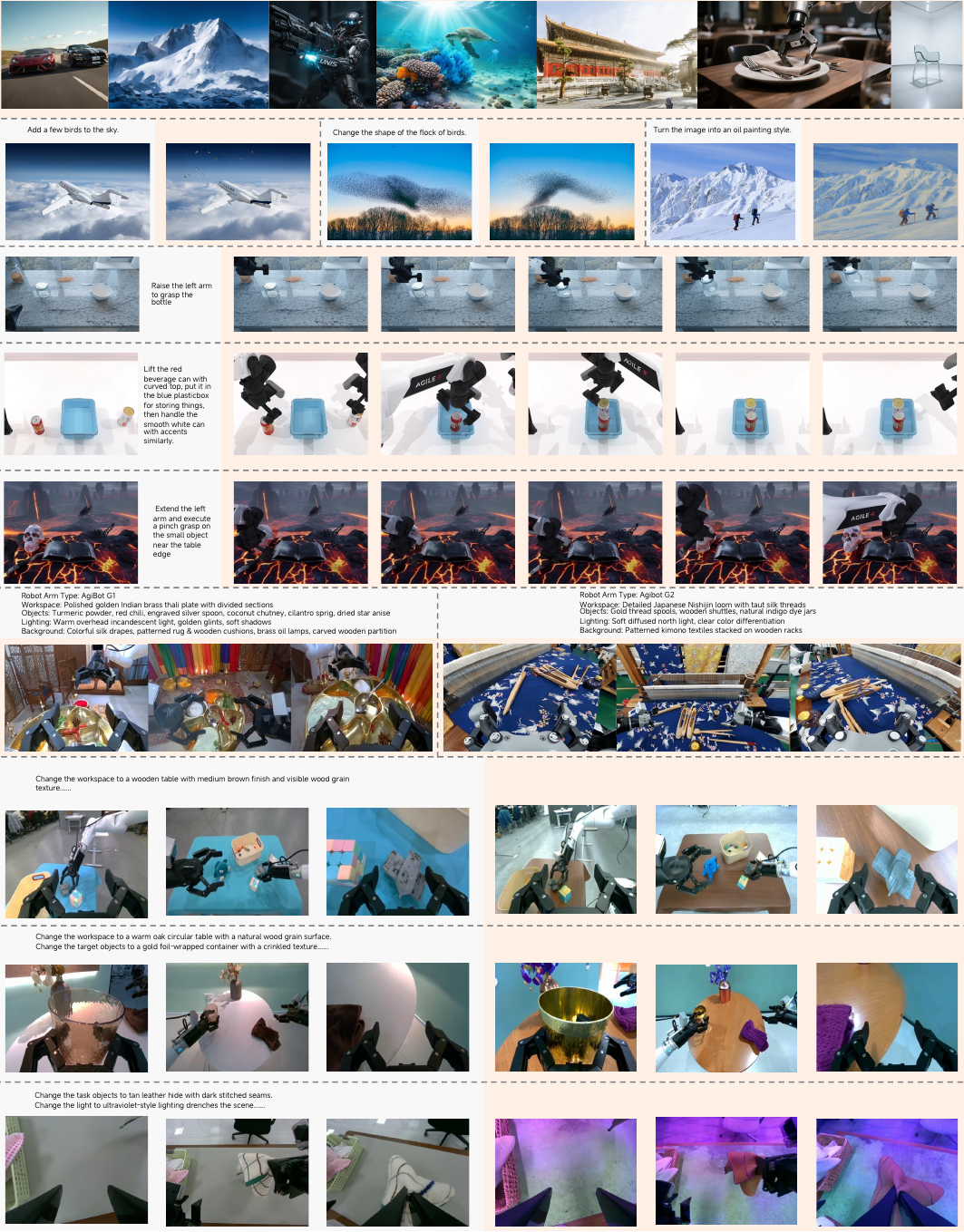
第二,论文提出统一的 multi-view embodied generation framework,覆盖 scene generation 与 controllable transfer。借助大规模 T2I/X2I 联合训练,模型强调跨视角一致性、细粒度可控性与 instruction following;结构化控制把 workspace、background、foreground irrelevant objects、target objects 和 lighting 解耦成独立维度,用于在保持几何与交互动力学的情况下规模化扩充具身视频。
第三,论文通过 interleaved subtask-subgoal learning 与 multi-FPS video generation,把静态具身合成扩展到 sequential embodied world modeling。模型能够从合成初始场景继续 rollout 长时域视频,从而把 foundation world model 转换为可扩展的 embodied data engine,为后续 policy learning 生成多样交互轨迹。
关键洞察
这篇论文真正的贡献不是把机器人数据再喂给一个图像模型,而是重新定义任务接口:只要输入和输出都能编码成多模态 token sequence,就可以使用同一个 next-token prediction objective 训练。机器人场景、图像编辑和视频预测因此成为同一模型中的不同数据形态。
方法与架构
本节导读:从统一 NTP objective、数据构造、模型结构到 FlashAR+ 推理加速,解释 U0 如何工作。
Problem Formulation
目标是构建一个统一的 embodied world model,在单一 autoregressive framework 下支持多种生成和预测任务。模型接收由文本、图像和机器人控制信号共同组成的多模态上下文,并预测其后的多模态序列。
\mathcal{C}=\{x_1,x_2,\cdots,x_n\}公式说明:该式定义模型可见的条件集合;它位于所有训练任务的输入端,约束不同模态先被编码到同一上下文中。它本身不是损失函数,但统一了任务接口,减少为不同任务设计独立输入头所造成的表示割裂。
P(\mathcal{Y}|\mathcal{C})=\prod_{t=1}^{T}P(y_t|y_{<t},\mathcal{C})公式说明:该式把文本、图像和机器人控制信号放在同一个序列建模问题中。它用于 single-step 与 sequential training 的共同目标,约束模型根据已有 context 和已生成 token 预测下一个 token,从而直接减少逐 token 预测误差,并让不同任务共享表示。
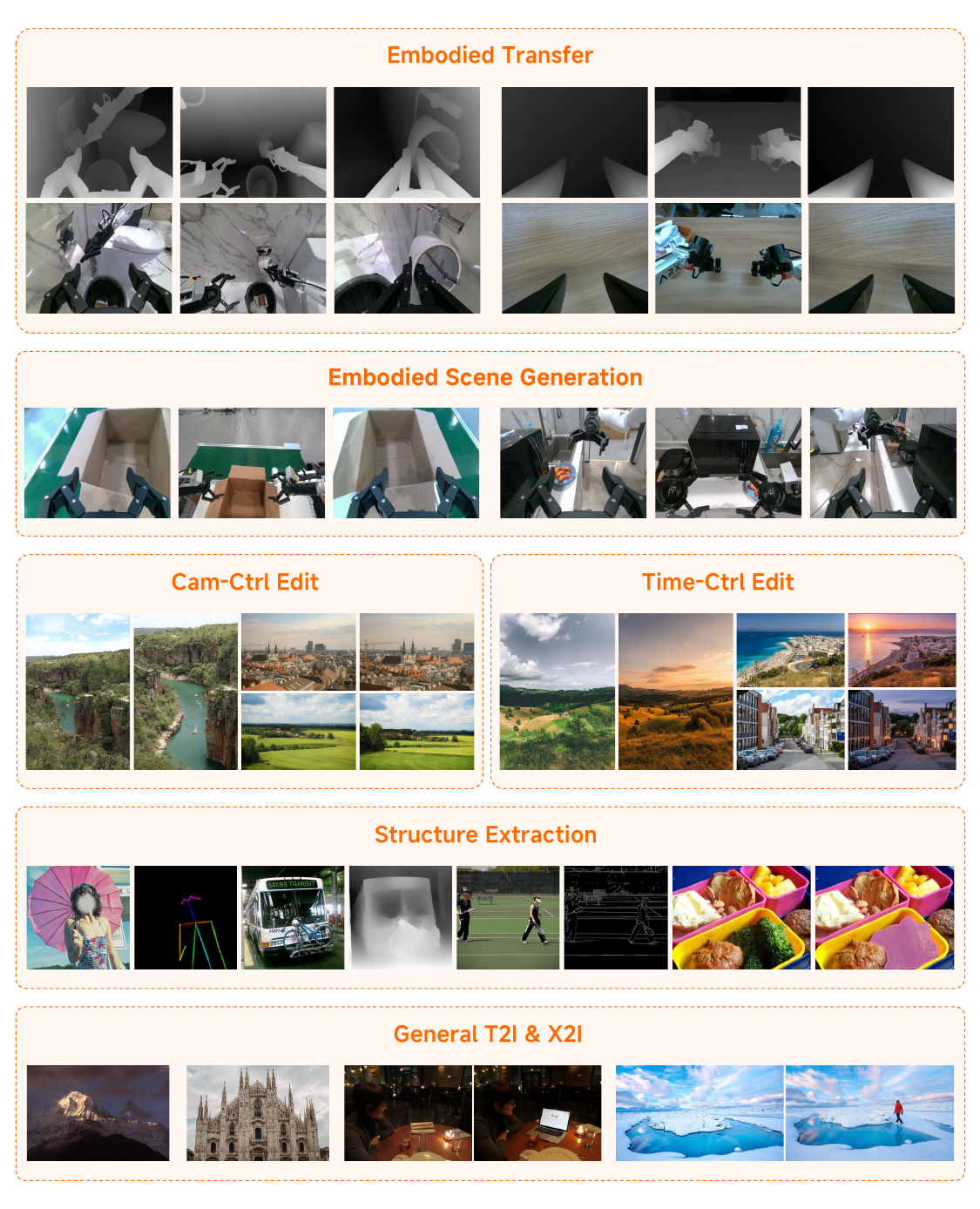
训练样本被分为两组。Single-step samples 描述没有显式时间演化的一次性输入输出映射:Text-to-Image(T2I)根据文本生成图像;Any-to-Image(X2I)根据文本和 1 至 3 张参考图完成编辑或生成;Embodied Scene Generation 根据 robot embodiment 与场景描述生成初始 multi-view observation;Embodied Transfer 则根据当前具身 observation 和目标场景描述预测迁移后的 multi-view observation。
Sequential samples 用于长时域交互与未来演化。第一类是 image-text interleaved subtask-subgoal sequences,每段子任务描述后跟随执行完成后的 multi-view observations;第二类是以多个 frame rate 采样的 embodied manipulation videos,稀疏序列刻画任务级转移,稠密序列刻画连续交互动力学。尽管语义不同,所有任务最终都表示成统一的多模态 token sequence,并在同一 autoregressive objective 下优化。
Model Architecture
模型使用开源 EMU3.5 作为初始化模型,其基础是 Qwen-3-32B decoder-only Transformer。图像首先通过 IBQ Tokenizer 编码,空间压缩比为 16×16;将 IBQ codebook 加入原始 Qwen vocabulary 后,文本和图像都可以在统一的离散 vocabulary 中通过 next-token prediction 建模。模型最终规模为 38B 参数。
与使用 task-specific prediction heads 的传统 embodied world model 不同,Xiaomi-Robotics-U0 把 image generation、embodied scene synthesis、scene transfer、sequential subtask prediction 和 video generation 都表述为单一 autoregressive sequence modeling problem。这样可以进行 multi-task co-training,并保留大规模预训练模型的视觉生成能力。
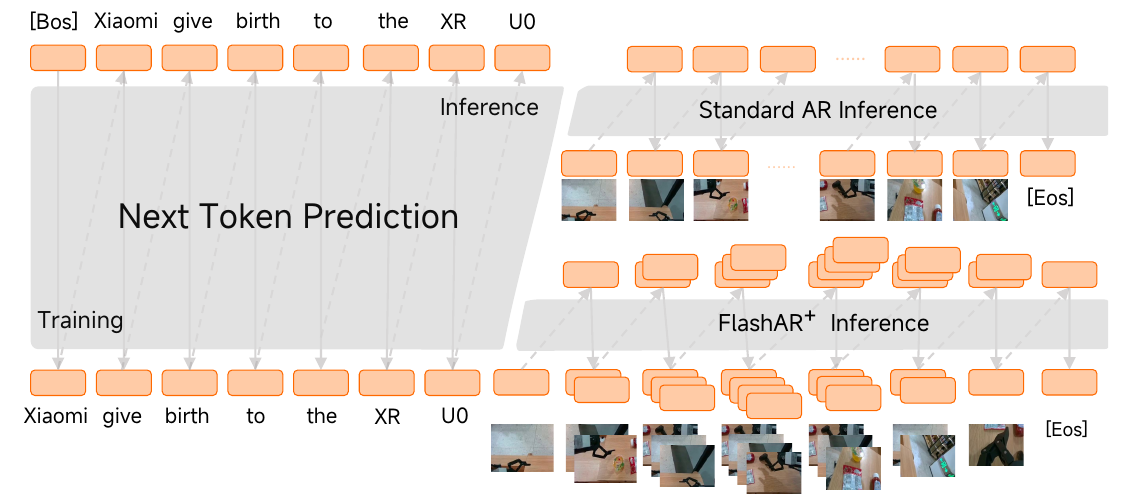
为提高推理效率,模型进一步采用受 FlashAR 启发的 inference-accelerating adaptation:额外加入 vertical prediction head,按 anti-diagonal 顺序解码图像 token,使同一对角步内的多个视觉 token 可以并行生成。结合优化的 KV-cache management 与 vLLM continuous batching,1024×1024 图像生成相对原始 NTP pattern 最多加速 82.9×,同时保留大部分生成质量。
Dataset and Unified Annotation
数据覆盖六个互补领域。General image-text 数据(如 ShareGPT4V)建立文本条件生成所需的视觉语义对齐;embodied manipulation 数据同时包含 AgiBotWorld-Beta、Open X-Embodiment、内部 MiBot 真实数据,以及 RoboTwin2.0、GenieSim、InternData-A1 仿真数据,使模型接触真实与难以实体采集的交互场景。
Autonomous driving 数据来自 Cosmos-Drive-Dreams,提供包含复杂布局、动态物体、天气、照明和交通条件的结构化室外场景;EgoWalk 的 egocentric 数据补充自然第一人称视角与运动模式;ScanNet++ v2 和 DL3DV-10K 的 3D reconstruction 数据提供密集 multi-view correspondence 与精确几何;Open-P2P 的 game 数据则把视觉分布扩展到风格化和程序生成环境。
大规模 raw data 经过 motion blur detection、image quality detection 和 gripper-state alignment 等过滤。最终 single-step generation 使用 950 万 samples、约 564 亿 tokens;sequential generation 使用 260 万 video clips、约 496 亿 tokens。
Dataset Labeling
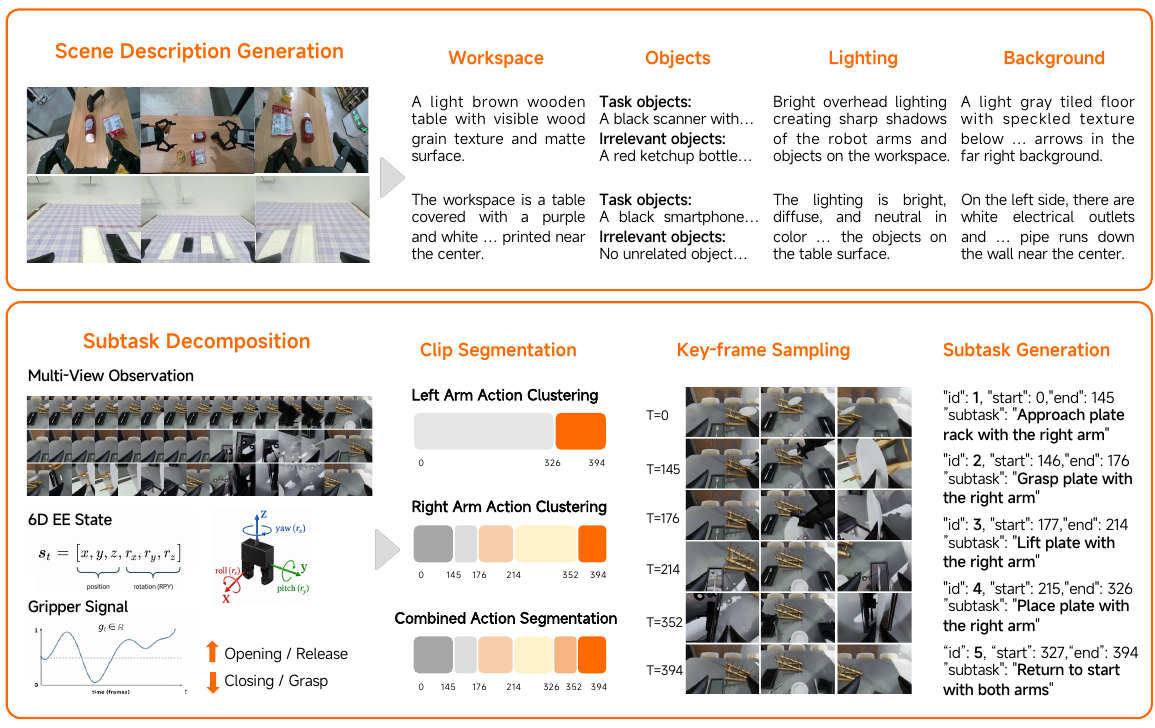
多数原始样本只有粗粒度 task-level 描述,无法支持精确的文本驱动具身生成。作者因此用 Qwen3-VL-235B 构建统一标注管线,为通用帧、多源视频和机器人操作轨迹生成 dense structured annotations,并把流程拆成四个目标相互独立的分支。
General Scene Annotation 不区分通用视频还是机器人视频:先在时间维下采样清晰关键帧,再由 VLM 为每帧描述整体布局、物体交互和跨物体空间关系。Structured Embodied Scene Annotation 只处理具身操作数据,并依据轨迹的子任务分解,把场景拆为 workspace、task objects、irrelevant objects、lighting 和 background 五个正交语义维度,分别生成与任务相关的描述。
Geometric Modality Extraction 使用 Video Depth Anything 为全部帧和视频提取时间一致的 inverse depth;亮像素代表近表面,暗像素代表远表面,作为跨域 Embodied Transfer 的几何条件。Trajectory-level Subtask Decomposition 使用 HDBSCAN,根据 end-effector pose 与 gripper signal 切分机器人轨迹,定位运动或抓取状态切换边界;在物理交互密集的边界处采样关键帧,并由 VLM 生成与 frame boundaries 对齐的 subtask plan。
Task-Oriented Data Organization
标注后的数据按三个训练目标重新组织。Embodied Transfer 的输入由 system instruction、scene description 和 multi-view depth maps 构成,监督目标是 multi-view RGB,训练模型从几何先验恢复 photorealistic appearance。Scene Generation 用 system instruction 与 scene description 直接监督 multi-view RGB,学习不依赖几何输入的 text-to-multi-view synthesis。
Video Generation 的输入包括 system instruction、task instruction 和 initial observation frame,监督目标是 15 至 25 帧 RGB 序列。若数据集提供 robot action label,还会把由 action 和 URDF 渲染的 robot mask sequence 接在初始帧后作为动作引导,使模型能根据任务语义、初始状态和显式 action guidance 预测未来视觉状态。
Data Balancing
多域语料容易让模型偏向样本占比更高的分布。作者按 data domain 与 generation task type(multi-view generation、scene editing、single-view generation)做 sample-level reweighting,核心目标是完整覆盖机器人操作场景。首先剔除视觉损坏、时间戳错位、缺少 proprioception/action signal、执行失败以及没有机器人-物体交互的静态轨迹。
剩余样本按 task goal、scene context、target object、spatial relation、subtask phase 和 atomic manipulation skill 分层分组。重复的 embodiment-task-object 组合被下采样;具有新视觉、新物体布局、新操作技能或新时间阶段的 clip 被优先保留;罕见物体、低频技能以及 grasping、releasing、placing、object-state transition 等关键交互阶段得到更高采样权重。这比简单 dataset-level weighting 更细,既减少重复演示,又保留视觉与技能覆盖。
Training
为了把预训练图像生成模型高效适配为 unified embodied world model,同时保留原始视觉生成能力,论文采用两种 continued training setup:single-step training 与 sequential training。
Single-step training 联合训练 T2I、X2I、Embodied Scene Generation 和 Embodied Transfer。T2I/X2I 持续强化预训练模型已有的通用生成与编辑能力,抑制 embodied adaptation 中的 catastrophic forgetting;Scene Generation 教模型根据 robot embodiment 与场景描述生成物理合理的初始 observation;Transfer 则学习在保持 robot interaction state 与 camera geometry 的同时做跨场景 multi-view generation。
Sequential training 把能力扩展到长时域推理和交互建模。image-text interleaved subtask-subgoal sequence 将语言子任务与执行后的 multi-view observations 配对,用来学习任务分解和未来 observation 预测。随后加入 InternData-A1、GenieSim、AgiBotWorld-Beta、RoboCOIN 与 RoboMIND 的大规模操作视频,并以 1、3、5 FPS 组织多时间分辨率序列:低 FPS 强化长时域规划与未来预测,高 FPS 捕获细粒度操作动力学和连续交互。
Inference
推理加速只作用于最终 target image region,reference images、文本与其他输入信号仍按原条件建模。所有先于目标图像的内容,包括 text instruction、reference images、control conditions 和 target-image header,都被视为 conditional prefix;并行 autoregressive loss 只在 target image 上计算,避免把参考图误当成生成目标。
FlashAR+ Extension
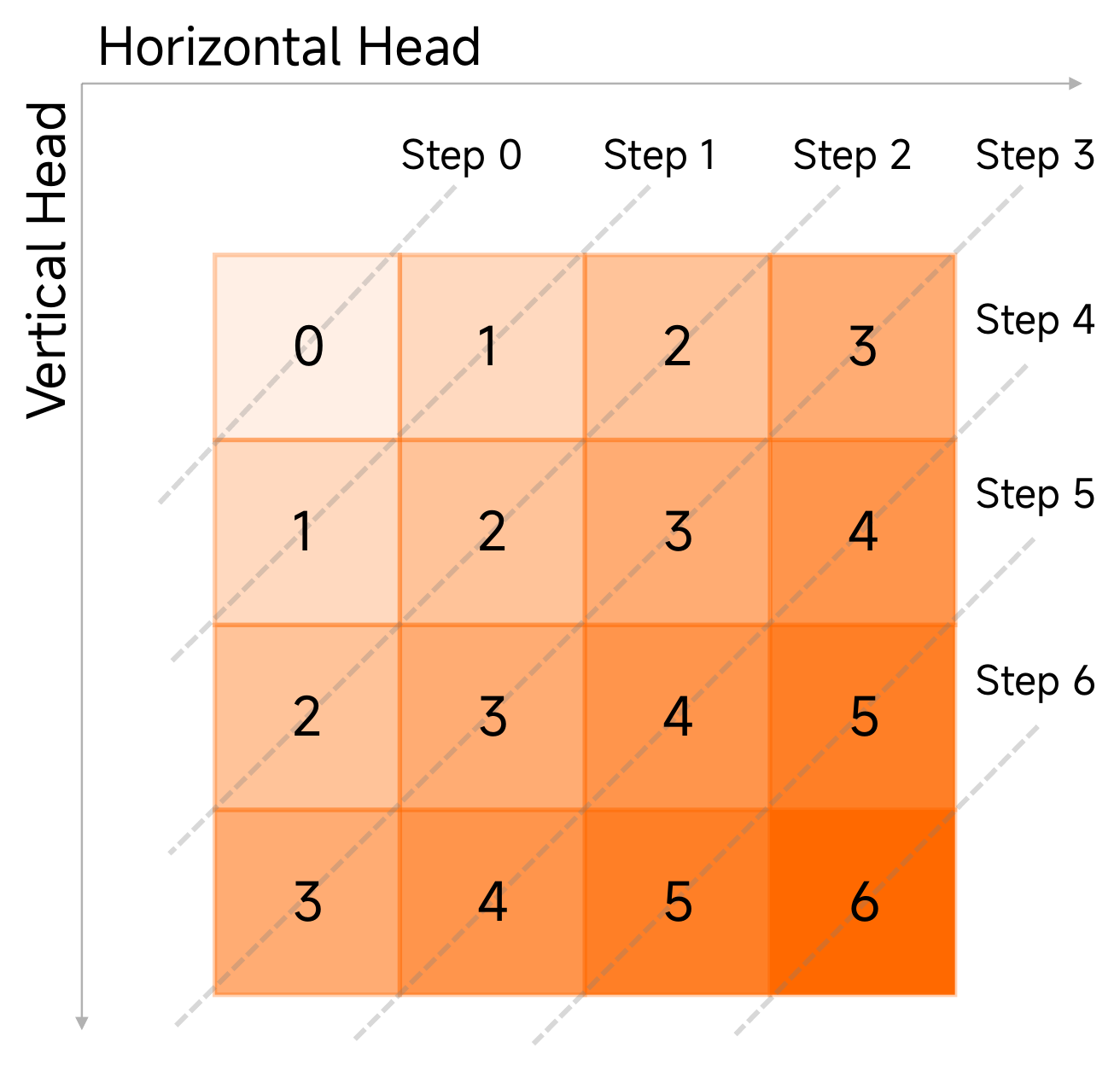
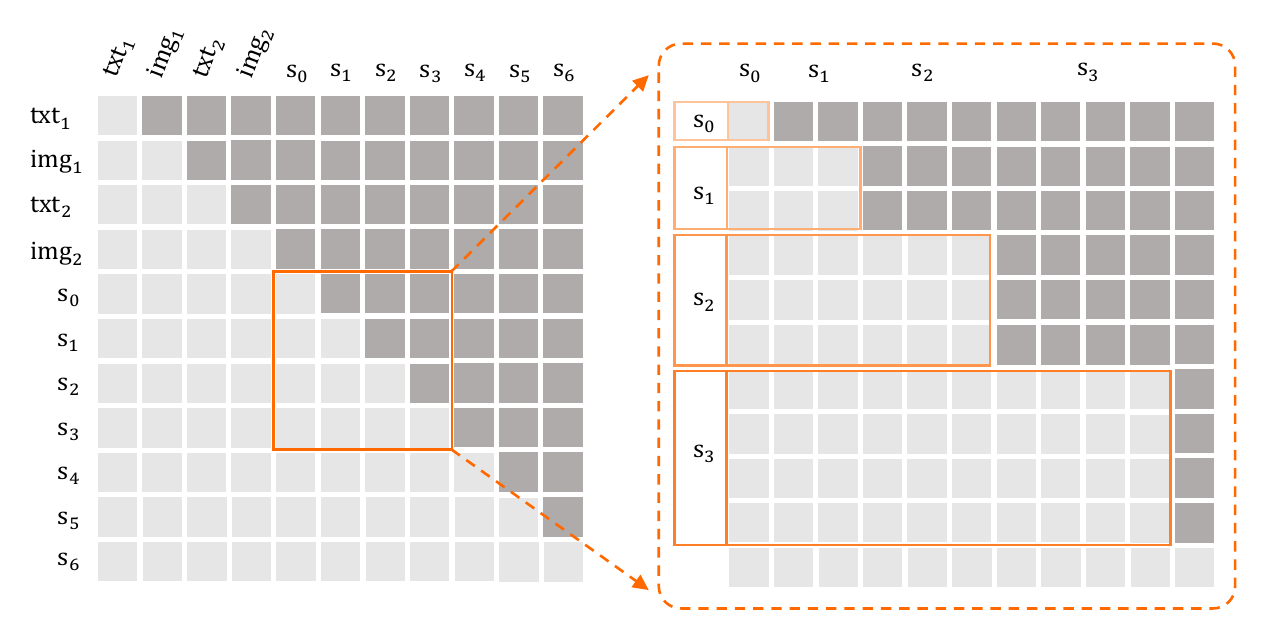
标准 AR 在 raster order 中逐 token 串行生成;FlashAR+ 把 target image 按 anti-diagonal steps 分组并行生成。Conditional prefix 保持标准自回归可见性,target token 可以看完整前缀,但在目标图内部只能看更早的对角步;同一步 token 彼此不可见,因而不会在训练时发生 future-information leakage。
| 方面 | 标准 AR | FlashAR+ | 作用 |
|---|---|---|---|
| 目标图生成 | raster order 串行逐 token | 按 anti-diagonal step 并行 | 减少串行解码步 |
| 目标图 attention | 一维 causal attention | 前缀全可见,图内二维 step-causal | 防止信息泄漏 |
| Prediction heads | 单 AR head | horizontal、vertical 与 gated fusion | 支持对角并行 |
| 辅助监督 | 标准监督 | H/V directional loss | 约束两个方向分支 |
M(q,k)={1}\left[s(r_k,c_k)<s(r_q,c_q)\right]公式说明:其中 s(r,c)=r+c 表示目标图 token 所属的 diagonal step。该 mask 用于 target-image attention:允许 query 看 conditional prefix 与更早的对角步,屏蔽同一步及未来步,从而减少并行训练中的信息泄漏,同时保留自回归因果性。
\mathcal{L}=\mathcal{L}_{\mathrm{fuse}}+0.05\mathcal{L}_h+0.05\mathcal{L}_v+0.2\mathcal{L}_{\mathrm{distill}}公式说明:L_fuse 监督 H/V gated fusion 后的 target-image prediction,L_h 与 L_v 以相同权重分别约束 horizontal 和 vertical heads,L_distill 让并行模型贴近原 AR teacher。该损失位于 FlashAR+ post-training 阶段,主要减少方向分支欠训练、gate collapse 与并行解码相对原 AR 分布的偏差。
z_{\mathrm{fuse}}(r,c)=g(r,c)z_h(r,c)+\left(1-g(r,c)\right)z_v(r,c)公式说明:g(r,c)∈[0,1] 是每个目标位置的 gate。该式在目标图内部融合 horizontal 与 vertical head 的 logits,使 interior position 能按内容选择更可靠的方向;它减少单方向预测在边界、结构纹理或局部依赖上的系统误差。
\mathcal{L}_{\mathrm{fuse}}=-\sum_{(r,c)\in\mathbf{Y}}\log\mathrm{softmax}\left(z_{\mathrm{fuse}}(r,c)\right)_{y_{r,c}}公式说明:该交叉熵在 target-image token 集合 Y 上计算,直接约束融合分布给真实 token 更高概率。它是 FlashAR+ 训练的主损失,用来减少最终并行生成结果的 token classification error;H/V 辅助损失则防止融合前的两个分支失去可用性。
论文特别指出,若 L_h=0,horizontal head 可能无法充分收敛,而 H/V gate 在训练后期又可能塌缩到这个欠训练分支,使融合预测退化为不稳定的单方向预测。加入 0.05L_h 后,两个方向受到对称的显式监督,融合过程更稳定。
FlashAR+ Inference and vLLM
推理时先把 text instruction 和 reference images 编码成 conditional prefix,再接 target-image header。模型仅在目标网格上按 r+c 递增逐步生成,同一步内所有位置并行采样;边界位置使用可用的单方向预测,内部位置使用 H/V gated fusion。这样既保留 X2I 的多源条件约束,又减少目标图区域的串行成本。
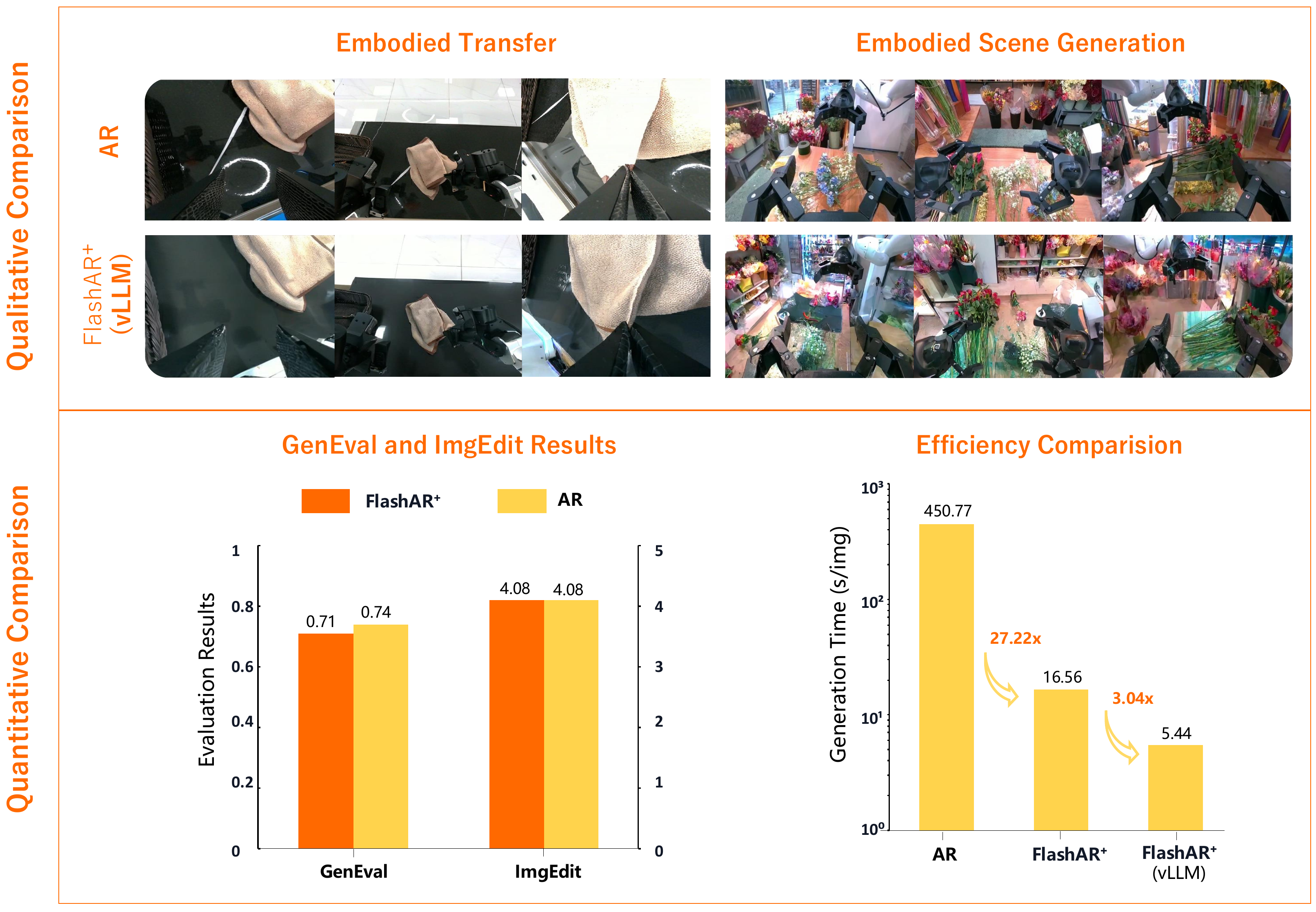
vLLM integration 不改变 FlashAR+ 的解码规则:vLLM 负责 conditional prefix、batched execution 与 paged KV-cache,diagonal scheduler 负责发射每个 anti-diagonal step 的视觉 token,并同步 classifier-free guidance 所需的 conditional/unconditional request。单张 H20 上生成 1024×1024 T2I 图像时,标准 AR 需 450.77 秒;FlashAR+ 降到 16.56 秒,较 AR 加速 27.22×;加入 vLLM 且 max_num_seq=28 后降到 5.44 秒,较 FlashAR+ 再加速 3.04×。
关键部分讲解:为什么要统一 token space?
如果场景生成、图像编辑和视频预测各自使用不同 head,通用视觉知识很难共享。U0 通过 tokenizer 和 control token 把不同模态放进同一个离散 vocabulary,模型只需学习‘在当前上下文后面应该出现什么 token’。这使通用图像能力成为具身能力的先验,而不是后训练时被丢弃的旧能力。
关键部分讲解:FlashAR+ 为什么仍然是 autoregressive?
并行发生在同一个 anti-diagonal step 内,而 step 与 step 之间仍按因果顺序推进。由于同一步 token 互相不可见,模型没有偷看答案;它只是把二维图像网格里没有先后依赖的一组位置一起解码。因此加速来自重新组织依赖图,而不是把模型改成 diffusion 或一次性生成器。
实验与结果
本节导读:覆盖 embodied transfer、scene generation、真实机器人、WorldArena 以及通用图像能力。
实验围绕 Embodied Transfer、Embodied Scene Generation、Real World Experiments、Video Generation 以及通用 T2I/Image Edit 五个方面展开。总体结果显示,模型在保留 general image capability 的同时,提高了多视角几何一致性、具身迁移可控性和真实机器人策略的分布外鲁棒性。
Embodied Transfer
作者构建了 300 个样本的 benchmark,每个样本包含文本场景描述和一组 multi-view depth maps,模型需要生成与深度条件一致的 multi-view RGB images。150 个 Easy 样本的描述接近原场景,150 个 Hard 样本要求生成较多训练分布中没有的新内容。评测从 depth consistency、structural fidelity 和 semantic grounding 三方面进行。
每个样本还提供原数据中的 multi-view RGB reference。参考图并不完全对应编辑后的描述,但包含 depth 之外的结构信息,供指标计算使用。Depth consistency 使用共享单目深度估计器比较生成图与参考图,报告 SI-RMSE(越低越好)、δ1(相对深度误差小于 1.25 的像素比例,越高越好)和 AbsRel(越低越好);structural fidelity 使用 Canny edge 的 F1、Precision、Recall;semantic grounding 使用 open-vocabulary detection/segmentation 的 mIoU 与 Recall。
| Metric | GPT Easy | GPT Hard | U0 Easy | U0 Hard |
|---|---|---|---|---|
| Depth SI-RMSE ↓ | 0.4007 | 0.3444 | 0.1407 | 0.1435 |
| Depth δ1 ↑ | 0.5307 | 0.5340 | 0.8017 | 0.7846 |
| Depth AbsRel ↓ | 0.4350 | 0.4045 | 0.1647 | 0.1702 |
| Canny F1 ↑ | 0.0519 | 0.0507 | 0.2066 | 0.1815 |
| Canny Precision ↑ | 0.0560 | 0.0536 | 0.2037 | 0.1770 |
| Canny Recall ↑ | 0.0572 | 0.0582 | 0.2290 | 0.2176 |
| Segmentation mIoU ↑ | 0.4105 | 0.4098 | 0.7621 | 0.7436 |
| Segmentation Recall ↑ | 0.6208 | 0.6524 | 0.8136 | 0.8032 |
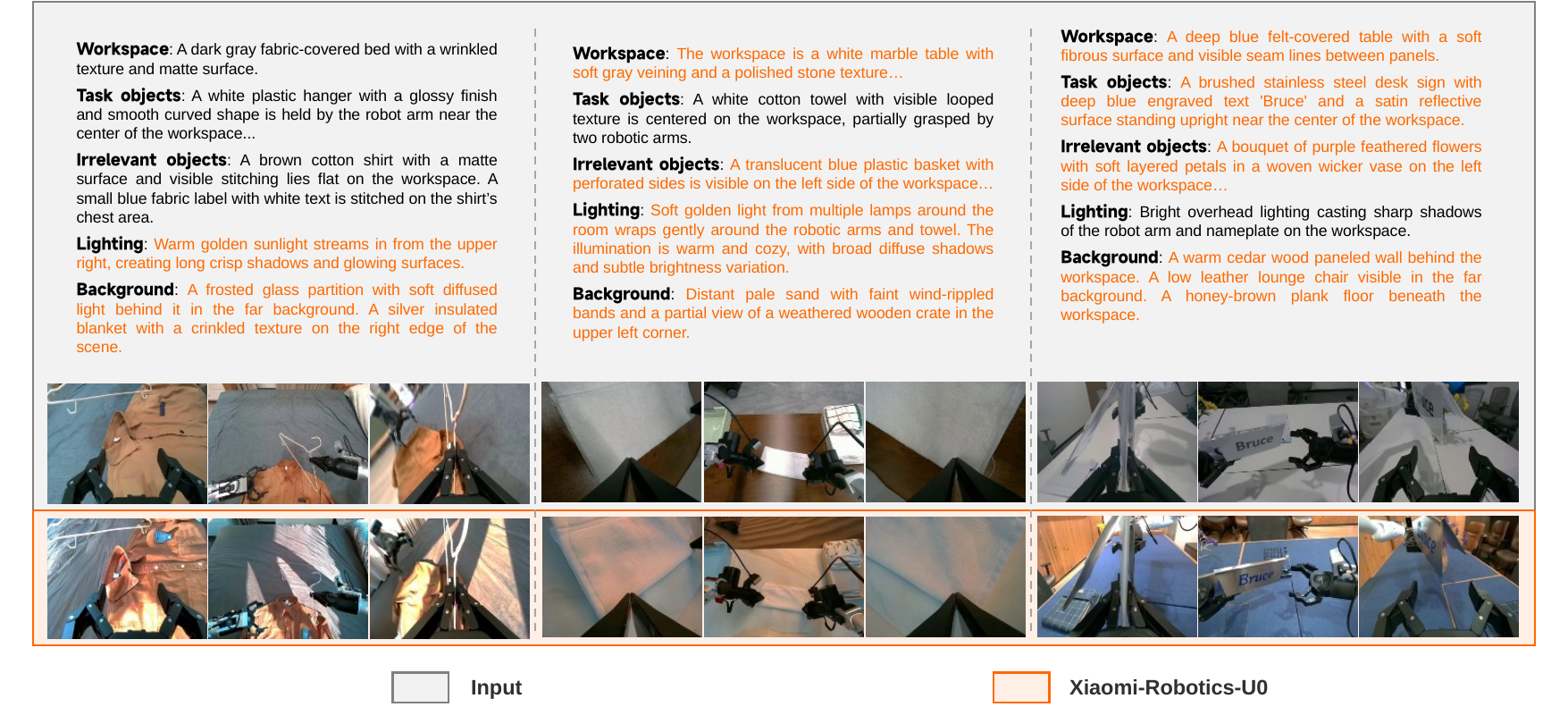
GPT-Image-2 在单张图像中通常具有不错的文本对齐和视觉质量,但会违反 depth conditions,并在同一场景的不同视角中产生互相冲突的对象位置、尺度和布局。U0 则遵守每个视角的几何约束,并保持跨视角一致。
作者还用 Embodied Transfer 做 zero-shot data augmentation:对每条真实轨迹,让 Qwen3-VL 为 background、workspace 和 lighting 等维度生成 1,000 个候选描述,随机组合后交给 U0 生成新场景。这样可以扩展机器人轨迹的视觉覆盖范围,同时保持原有 robot states 和 action labels。
该扩充应用于 Pack Box、Fold Towel、Pack Phone 和 Pack Earphone 四项真实任务。Task objects 保持不变,其余维度尽量多样化;论文强调这些组合没有出现在训练集中,因此这项实验检验的是 zero-shot visual coverage expansion,而非重放训练场景。
Embodied Scene Generation
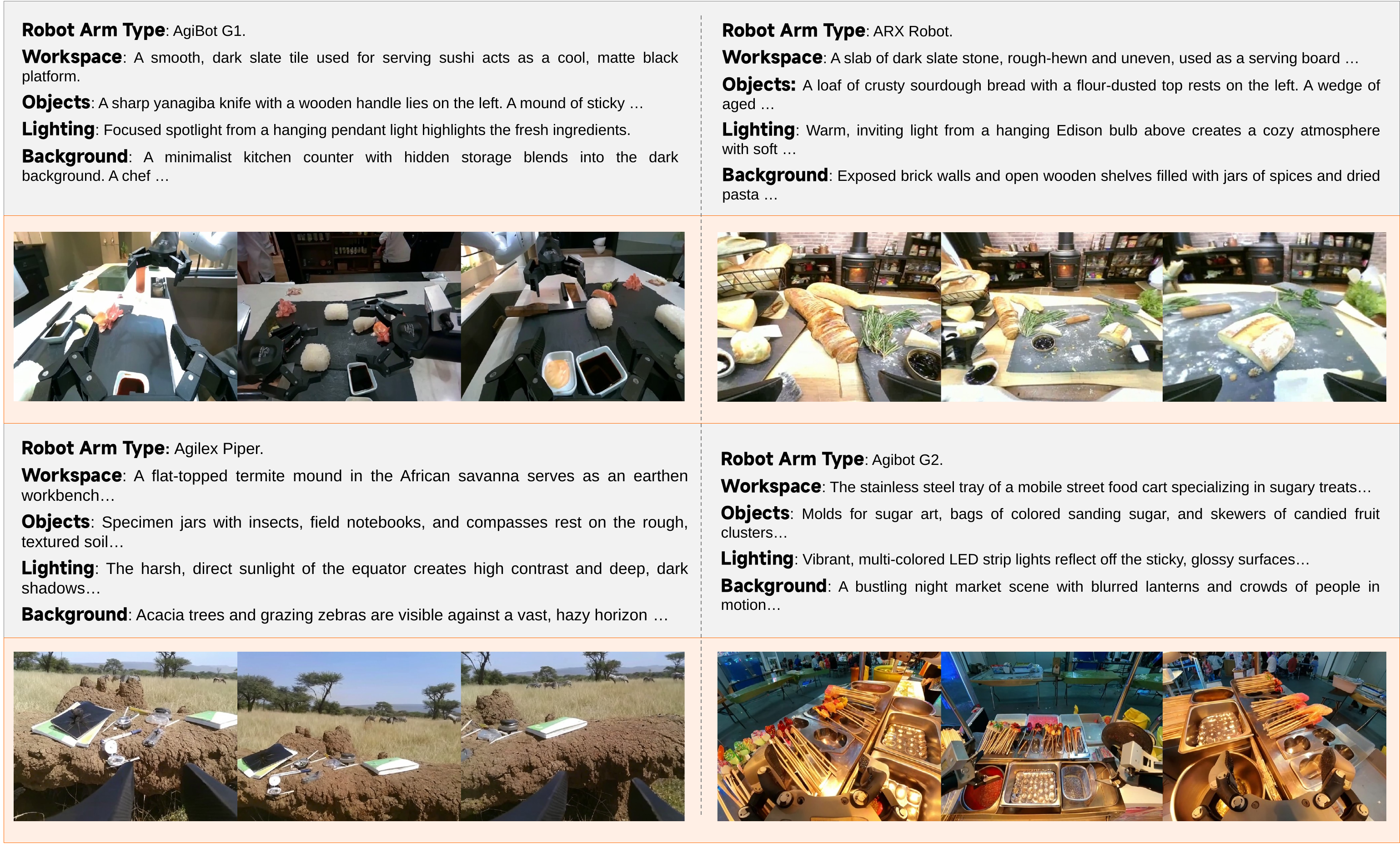
Scene generation benchmark 包含 400 个样本:200 个 Easy indoor manipulation scenes 和 200 个 Hard open-domain scenes。每个 prompt 指定 robot arm type,以及 workspace layout、object configuration、lighting 和 background。由于没有可靠的自动指标评估全局跨视角 3D coherence,作者使用随机左右顺序的人工 pairwise evaluation,比较 multi-view geometric consistency 和 textual instruction following。U0 在大多数比较中胜过 GPT-Image-2,同时保持 photorealistic quality。
为公平比较,GPT-Image-2 还会获得与目标 robot arm type 对应的 multi-view reference images 作为视觉上下文。标注者看到随机打乱左右顺序的两组输出,以降低位置偏好;multi-view consistency 要求跨视角的对象位置、尺度和遮挡对应同一个 3D layout,instruction following 则核对 workspace、objects、lighting 与 background 是否符合 prompt。
值得注意的是,四种 robot arm 中 AGIBOT G2 只在 simulation data 上训练,U0 仍能为它生成符合真实世界视觉先验的 observation,显示出潜在的 sim-to-real generalization。
Real World Experiments
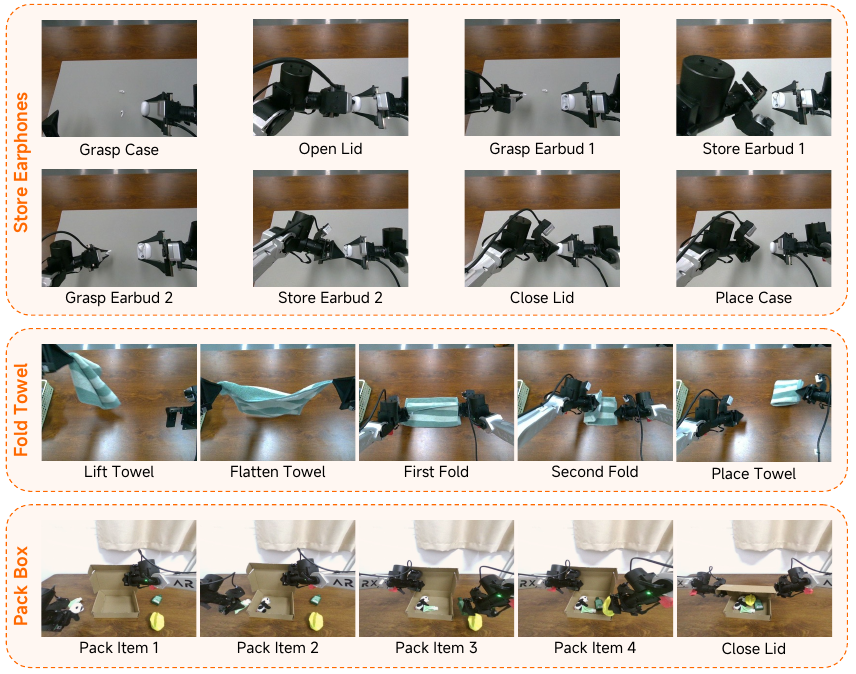
真实世界实验研究生成数据是否能改善下游 policy learning。三项任务是 Store Earphones、Fold Towel 和 Pack Box,分别代表灵巧操作、可变形物体处理和多物体交互。每个任务使用约 40 小时真实 demonstration;U0-Aug 再生成约 40 小时 style-transferred episodes,改变背景、lighting 和 textures,但保留 robot states 与 action labels。Original policy 只使用 clean data,U0-Aug 使用 clean data 与 augmentation 的混合。
每项任务都从 pi05_base checkpoint 出发,使用官方 PyTorch 实现独立 post-train 一个 π0.5 policy;除 supervised fine-tuning data mixture 外,所有训练设置完全一致。机器人执行时不挂载 world model,U0 只通过训练数据影响 policy,因而实验测到的是数据增强价值,而不是推理时额外模型的收益。
每个 group 含 3 种 object-layout variant,两种 policy 按相同条件日程评测。Base group 只改变物体位置,背景 tablecloth 来自 demonstration,使用标准实验室照明;interference group 同样随机布局,但换成训练中未见、纹理和反射更复杂的 tablecloth,并加入低照度、彩色光与 disco-ball 式动态投影。每个 policy-task pair 共 2 groups × 3 layouts × 3 trials = 18 次真实机器人 rollout。
平台是双臂 ARX robot:两条 6-DoF arm,各带 1-DoF parallel-jaw gripper。Observation 包括 proprioceptive arm state、1 个 head RGB view 与左右 wrist RGB view;耳机和毛巾任务使用 Intel RealSense D405,装箱任务为覆盖更大工作区改用鱼眼相机并在输入前去畸变。Policy server 通过局域网 WebSocket 与控制进程通信,机器人以 1 Hz 上传状态和三路图像,服务器返回执行到下一次 query 的 action chunk。
\mathrm{Prog}(t,g)=\frac{1}{N}\sum_{i=1}^{N}\frac{\ell_i}{K_t}公式说明:K_t 是任务的 milestone 数,ℓ_i 是第 i 次 rollout 完成的前缀 milestone 数,N 是该 task/group 的 rollout 数。该式用于真实机器人评测而非模型训练;它减少只统计 full success 时对早期子目标能力的测量误差,更准确反映长时域策略表现。
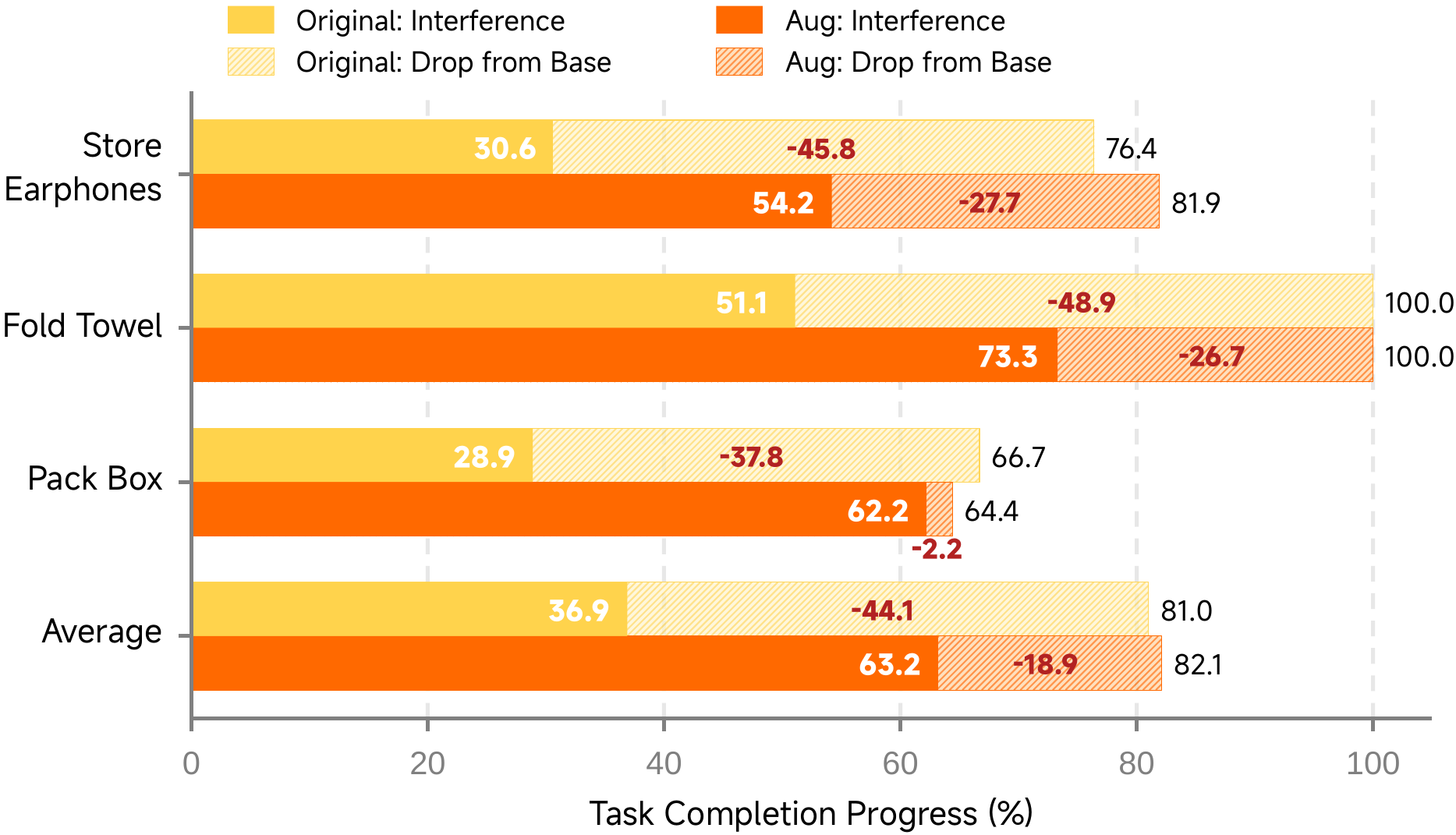
每个 task、evaluation group 和 layout 运行三次真实机器人试验。Base group 只改变物体摆放,使用训练中见过的 tablecloth 和正常灯光;interference group 使用未见过的 tablecloth、低光、彩色光和 disco-ball 式动态图案。结果显示 U0-Aug 在 base group 与 Original 大致相当,但在 interference group 的所有任务上都更好,说明 style-transferred augmentation 学到了对新背景和 lighting 的视觉不变性。
Base group 上 U0-Aug 偶尔略低于 Original,这是增强数据占用训练容量、却没有为 in-distribution 场景增加新信息的预期代价;但 distribution shift 下的收益明显超过这点损失。典型成功 rollout 显示,U0-Aug 在新 tablecloth、彩色照明和投影图案下仍能完成收纳两只耳塞并合盖、完整折叠毛巾,以及放入四件物体后关箱。
失败分析列出六类典型错误:饱和光照下抓不到耳塞;误判耳机盒方向;毛巾与桌布视觉相近时找不到边缘;因未完整抓住布边而把已折好的毛巾重新展开;以及两例把投影光斑当作目标去抓。两种 policy 在严重视觉污染下都可能异常,但 U0-Aug 更常继续正确动作或短暂偏离后自我修正;Original 更容易卡在视觉伪影上或进入不可恢复状态。
Embodied Video Generation and WorldArena
| WorldArena 指标 | U0 | SisyphusWorld | BWM-Fast | SACWM | DexWorldEngine |
|---|---|---|---|---|---|
| Image Quality | 53.94 | 45.57 | 51.22 | 45.83 | 51.44 |
| Aesthetic Quality | 40.79 | 38.38 | 40.15 | 37.30 | 40.96 |
| JEPA Similarity | 90.60 | 96.58 | 97.87 | 96.26 | 86.71 |
| Dynamic Degree | 73.70 | 76.27 | 69.58 | 70.35 | 69.16 |
| Flow Score | 86.02 | 99.82 | 75.11 | 95.79 | 74.31 |
| Motion Smoothness | 95.51 | 91.42 | 94.33 | 90.60 | 94.27 |
| Subject Consistency | 79.05 | 82.11 | 81.42 | 82.17 | 81.46 |
| Background Consistency | 86.44 | 86.52 | 90.17 | 87.90 | 88.85 |
| Photometric Consistency | 2.13 | 5.69 | 3.08 | 6.50 | 4.42 |
| Interaction Quality | 87.30 | 71.98 | 79.88 | 72.28 | 81.04 |
| Trajectory Accuracy | 41.89 | 44.58 | 44.89 | 46.95 | 51.41 |
| Depth Accuracy | 85.25 | 94.85 | 86.41 | 94.99 | 86.19 |
| Perspectivity | 98.84 | 90.34 | 97.14 | 92.34 | 97.58 |
| Instruction Following | 93.86 | 82.68 | 90.22 | 81.66 | 92.62 |
| Semantic Alignment | 89.35 | 89.18 | 89.15 | 89.16 | 89.45 |
| EWMScore | 73.64 | 73.06 | 72.71 | 72.67 | 72.66 |
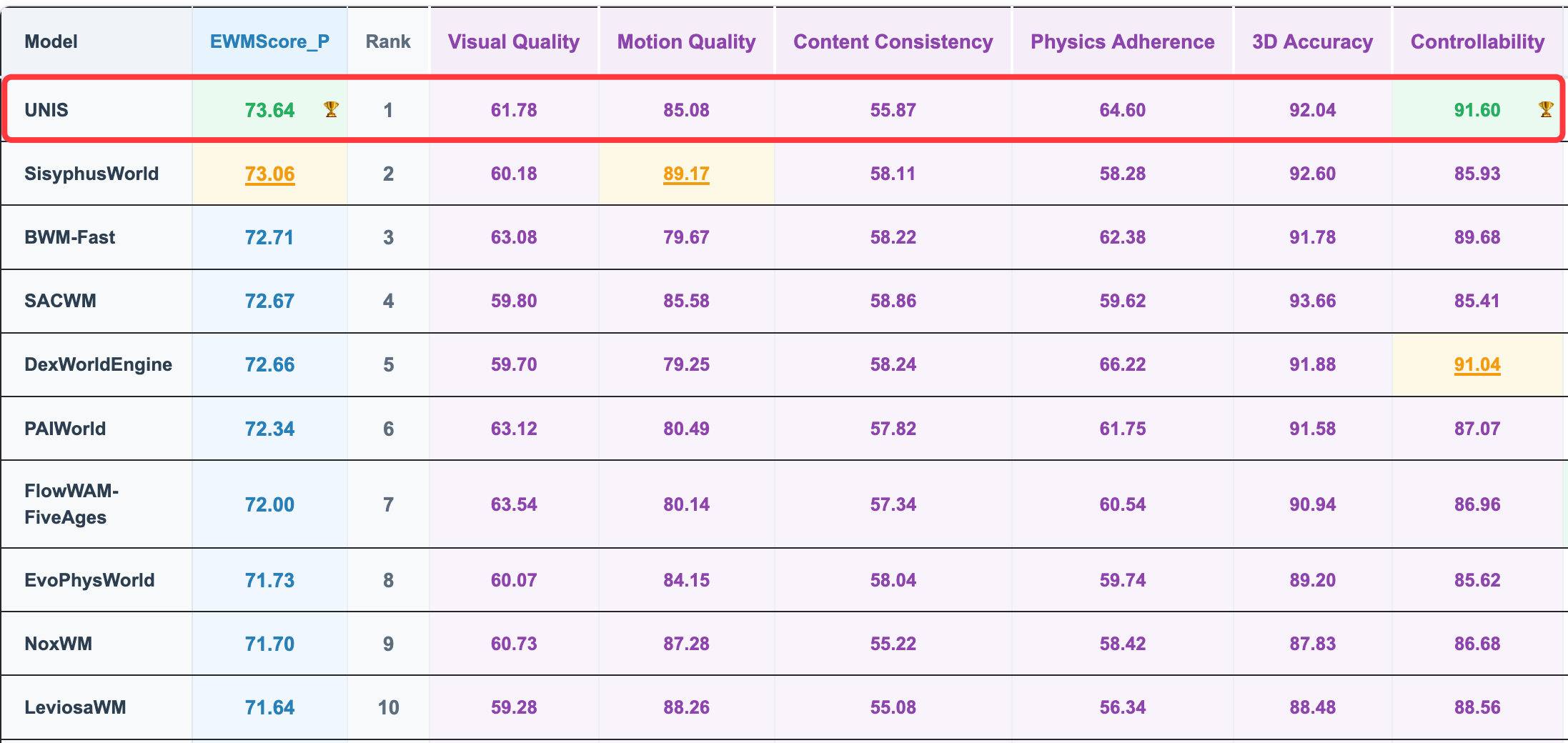
WorldArena 从 visual quality、motion quality、content consistency、physics adherence、3D accuracy 和 controllability 六个维度共 15 个指标评估视频。模型处理初始 frame、language instruction 和 robot action,并通过由 action、camera parameters 与 URDF 渲染的 robot mask sequence 提供动作引导;输出形式是带空 language token 的多帧 interleaved sequence。U0 的 EWMScore 为 73.64,在 100 多个提交模型中排名第一。
分项上,U0 的 Instruction Following 为 93.86、Interaction Quality 为 87.30、Perspectivity 为 98.84、Motion Smoothness 为 95.51,均为对比中的最高值。它并非每个指标都第一,例如 Trajectory Accuracy 和 Depth Accuracy 仍落后于个别模型;论文的结论是 U0 在各维度之间取得最佳综合平衡,而不是全面统治所有子指标。
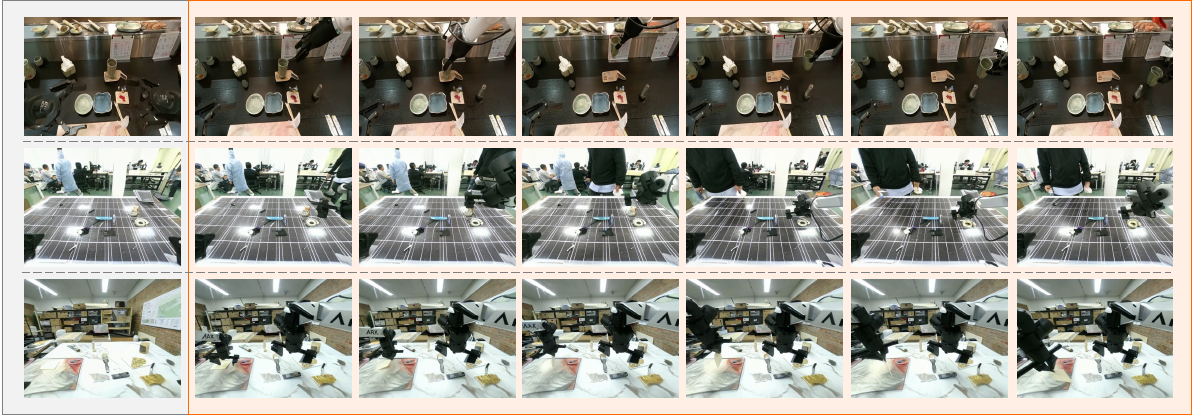
在 WorldArena 之外,作者还先用 U0 生成全新的 initial scene,再按语言指令生成后续视频。示例中,robot arm 能抓起杯子、抬升并稳定放回桌面;另一个序列同时模拟背景人物走近桌面;纸张示例则表现出弯曲以及横向移动时因低质量产生的轻微滞后,用来说明模型对 scene-level dynamics、接触和可变形物体物理的建模能力。
通用 T2I 与 Image Edit
这组评测的目的不是宣称 U0 是专用 open-domain image generator,而是量化模型向具身场景适配后保留了多少通用生成和编辑能力。GenEval 用于 compositional T2I,分数范围为 0–1;ImgEdit Basic 用于 single-turn image editing,judge 分数范围为 1–5。
| GenEval | Overall | Single object | Two object | Counting | Colors | Position | Attribute binding |
|---|---|---|---|---|---|---|---|
| Qwen-Image | 0.87 | 0.99 | 0.92 | 0.89 | 0.88 | 0.76 | 0.77 |
| U0-AR | 0.74 | 0.99 | 0.92 | 0.49 | 0.88 | 0.60 | 0.53 |
| ImgEdit Basic | Overall | Add | Adjust | Extract | Replace | Remove | Background | Style | Hybrid | Action |
|---|---|---|---|---|---|---|---|---|---|---|
| Qwen-Image | 4.27 | 4.38 | 4.16 | 3.43 | 4.66 | 4.14 | 4.38 | 4.81 | 3.82 | 4.69 |
| U0-AR | 4.08 | 4.21 | 4.15 | 3.28 | 4.35 | 4.21 | 4.03 | 4.72 | 3.27 | 4.53 |
U0-AR 的 GenEval overall 为 0.74,Qwen-Image 为 0.87;ImgEdit overall 为 4.08,Qwen-Image 为 4.27。U0 在 single/two object、colors、Adjust 和 Remove 等常见生成或局部编辑上接近甚至局部超过基线,下降主要集中于 Counting、Position、Attribute binding、Hybrid 等需要 multi-constraint composition、精确 spatial grounding 或 symbolic binding 的复杂场景。结果支持‘没有 catastrophic forgetting’,但不等于通用能力毫无代价。
实验结论
U0 的模型收益是三层叠加的:多视角几何让 scene/transfer 更可靠;长视频建模让生成结果能够 rollout 成 trajectory;生成的 trajectory 又能反过来增强 policy 在真实分布偏移下的鲁棒性。
局限与批判性阅读
本节导读:区分论文已经证明的能力与仍需要更多验证的外推结论。
本文将模型定位为统一的 embodied world model 和可扩展的数据引擎。关键机制是 continual multi-task training,而不是把 foundation model 完全改造成 robot-only model。模型通过统一 token sequence 共享视觉知识,再用 depth、robot mask、URDF、camera information 和 temporal video 数据补充具身约束。
局限 1:Transfer 依赖 depth
Embodied transfer 仍把 depth estimation 作为中间表示,深度估计误差可能引入伪影,并限制对物体纹理和局部外观的细粒度控制。未来方向是直接在 raw multi-view observations 上做 embodied multi-view image editing。
局限 2:Scene 与 video 仍分阶段
当前 embodied scene generation 和 video generation 是分开的,长时域 rollout 可能累积误差。将场景生成和后续视频生成联合起来,可能获得更连续的 world model。
局限 3:Context window
当前 32K context window 限制了长时间视频建模。扩展到更长 context 后,模型才更可能支持 minute-level embodied interaction generation。
批判性阅读
论文的强项是任务统一和数据引擎闭环,证据覆盖图像、视频和真实机器人三层。但通用 T2I/Image Edit 指标相较专门模型略低,说明保持 general capability 并不等于完全不付出代价;同时,WorldArena 与真实机器人结果依赖特定 benchmark、robot platform 和数据构造,外推到其他 embodiment 仍需要更多验证。
结论
本节导读:总结统一建模和闭环数据生成的意义。
本文提出 Xiaomi-Robotics-U0,一个在 world foundation model 上通过 general-domain 与 embodied datasets 的 continual training 得到的统一 embodied synthesis model。它在单一 autoregressive framework 内统一 text-to-image、image editing、multi-view embodied scene generation、embodied transfer 和 embodied video generation,并将 foundation model 的视觉知识迁移到 embodied intelligence。
实验表明,U0 在 single-step 和 sequential embodied generation 上取得 state-of-the-art,在人工评测中超过 GPT-Image-2.0,在 WorldArena 上取得领先结果,并通过生成数据提升下游 robot policy 的鲁棒性。论文希望这成为构建可扩展 agentic data engine 的一步:模型不仅预测世界,还能持续生成更多样的机器人经验。
贡献分工
本节导读:保留论文对项目负责人、数据、训练、部署、加速与基础设施等角色的完整署名。
论文按角色列出完整贡献者。星号表示核心贡献者,按名字字母顺序排列;双星号表示外部贡献者。以下姓名与分工保持论文原文,不翻译人名。
项目负责人
Xinghang Li
数据
Jun Guo*;Qiwei Li*;Hang Lai*;Long Qian*;Yueze Wang*;Nan Sun*;Hongyu Yan*;Jingen Qu;Jiaxi Song;Jiahang Cao;Hanye Zhao;Heyun Wang;Yunhong Wang;Jiaxi Song;Caoyu Xia;Jack Zhao
训练
Jun Guo*;Qiwei Li*;Long Qian*;Yueze Wang*;Jingen Qu;Jiaxi Song;Nan Sun;Hongyu Yan
部署与实验
Jiahang Cao*;Jun Guo*;Hang Lai*;Qiwei Li*;Long Qian*;Jiaxi Song*;Hongyu Yan*;Hanye Zhao*;Futeng Liu;Wanli Peng
推理加速
Xi Chen*;Jingen Qu*
基础设施
Xinghang Li*;Jingen Qu;Xi Chen
高级负责人
Jason Li*;Diyun Xiang;Hangjun Ye;Heng Qu;Huaping Liu**
致谢
本节导读:翻译论文致谢正文,并完整保留被感谢者姓名。
作者衷心感谢更广泛团队给予的大力支持,包括未在上方贡献列表中列出的 Li Jiang、Zhiyin Lai、Xiaoke Xilinjueluo、Qingyi Li、Qi Liu、Yayun Liu、Jun Xia、Feng Qiu、Donghao Wang、Yan Hou、Dong Wang、Quanyun Zhou、Liangliang He、Jiaxin Liu、Kang Zhou、Rui Cai、Shuoxue Bi、Yingchao Zhou、Kun Ma 和 Yiwei Zhou。
参考文献
本节导读:保留正文实际引用文献的英文 bibliographic entries,便于继续追踪相关工作。
参考文献条目保留英文题名和原始 bibliographic 信息,不翻译文献内容。下列条目从 arXiv TeX Source 的 main.bib 中筛选,仅保留正文实际引用的文献。
- Agarwal, Niket; Ali, Arslan; Allen, Jon; Antolini, Martin; Aubame, Adeline; Azzolini, Alisson; Bai, Junjie; Bala, Maciej; Balaji, Yogesh; Bapst, Josh; others (2026). Cosmos 3: Omnimodal world models for physical ai. arXiv preprint arXiv:2606.02800.
- Akhtyamov, Timur; Mdfaa, Mohamad Al; Benavides, Javier Antonio Ramirez; Nigmatzyanov, Arthur; Bakulin, Sergey; Devchich, German; Fatykhov, Denis; Salinas, Diego Ruiz; Mazurov, Alexander; Zipa, Kristina; others (2025). Egowalk: A multimodal dataset for robot navigation in the wild. arXiv preprint arXiv:2505.21282.
- Black Forest Labs; Stephen Batifol; Andreas Blattmann; Frederic Boesel; Saksham Consul; Cyril Diagne; Tim Dockhorn; Jack English; Zion English; Patrick Esser; Sumith Kulal; Kyle Lacey; Yam Levi; Cheng Li; Dominik Lorenz; Jonas Müller; Dustin Podell; Robin Rombach; Harry Saini; Axel Sauer; Luke Smith (2025). FLUX.1 Kontext: Flow Matching for In-Context Image Generation and Editing in Latent Space.
- Blattmann, Andreas; Dockhorn, Tim; Kulal, Sumith; Mendelevitch, Daniel; Kilian, Maciej; Lorenz, Dominik; Levi, Yam; English, Zion; Voleti, Vikram; Letts, Adam; others (2023). Stable video diffusion: Scaling latent video diffusion models to large datasets. arXiv preprint arXiv:2311.15127.
- Brohan, Anthony; Brown, Noah; Carbajal, Justice; Chebotar, Yevgen; Dabis, Joseph; Finn, Chelsea; Gopalakrishnan, Keerthana; Hausman, Karol; Herzog, Alex; Hsu, Jasmine; others (2022). RT-1: Robotics Transformer for Real-World Control at Scale. arXiv preprint arXiv:2212.06817.
- Brooks, Tim; Holynski, Aleksander; Efros, Alexei A (2023). Instructpix2pix: Learning to follow image editing instructions. Proceedings of the IEEE/CVF conference on computer vision and pattern recognition.
- Bruce, Jake; Dennis, Michael D; Edwards, Ashley; Parker-Holder, Jack; Shi, Yuge; Hughes, Edward; Lai, Matthew; Mavalankar, Aditi; Steigerwald, Richie; Apps, Chris; others (2024). Genie: Generative interactive environments. Forty-first International Conference on Machine Learning.
- Bu, Qingwen; Cai, Jisong; Chen, Li; Cui, Xiuqi; Ding, Yan; Feng, Siyuan; Gao, Shenyuan; He, Xindong; Hu, Xuan; Huang, Xu; others (2025). AgiBot world colosseo: A large-scale manipulation platform for scalable and intelligent embodied systems. arXiv preprint arXiv:2503.06669.
- Chen, Sili; Guo, Hengkai; Zhu, Shengnan; Zhang, Feihu; Huang, Zilong; Feng, Jiashi; Kang, Bingyi (2025). Video depth anything: Consistent depth estimation for super-long videos. Proceedings of the Computer Vision and Pattern Recognition Conference.
- Chen, Tianxing; Chen, Zanxin; Chen, Baijun; Cai, Zijian; Liu, Yibin; Li, Zixuan; Liang, Qiwei; Lin, Xianliang; Ge, Yiheng; Gu, Zhenyu; others (2025). Robotwin 2.0: A scalable data generator and benchmark with strong domain randomization for robust bimanual robotic manipulation. arXiv preprint arXiv:2506.18088.
- Chen, Xi; Huang, Lianghua; Liu, Yu; Shen, Yujun; Zhao, Deli; Zhao, Hengshuang (2024). Anydoor: Zero-shot object-level image customization. Proceedings of the IEEE/CVF conference on computer vision and pattern recognition.
- Chen, Xiaokang; Wu, Zhiyu; Liu, Xingchao; Pan, Zizheng; Liu, Wen; Xie, Zhenda; Yu, Xingkai; Ruan, Chong (2025). Janus-pro: Unified multimodal understanding and generation with data and model scaling. arXiv preprint arXiv:2501.17811.
- Chen, Yuzhi; Chen, Ronghan; Huo, Dongjie; Yang, Yandan; Qi, Dekang; Liu, Haoyun; Lin, Tong; Zeng, Shuang; Xiao, Junjin; Chang, Xinyuan; others (2026). Abot-physworld: Interactive world foundation model for robotic manipulation with physics alignment. arXiv preprint arXiv:2603.23376.
- Chenghao Yin; Da Huang; Di Yang; Jichao Wang; Nanshu Zhao; Chen Xu; Wenjun Sun; Linjie Hou; Zhijun Li; Junhui Wu; Zhaobo Liu; Zhen Xiao; Sheng Zhang; Lei Bao; Rui Feng; Zhenquan Pang; Jiayu Li; Qian Wang; Maoqing Yao (2026). Genie Sim 3.0 : A High-Fidelity Comprehensive Simulation Platform for Humanoid Robot.
- Cui, Yufeng; Chen, Honghao; Deng, Haoge; Huang, Xu; Li, Xinghang; Liu, Jirong; Liu, Yang; Luo, Zhuoyan; Wang, Jinsheng; Wang, Wenxuan; others (2025). Emu3. 5: Native multimodal models are world learners. arXiv preprint arXiv:2510.26583.
- Deng, Chaorui; Zhu, Deyao; Li, Kunchang; Gou, Chenhui; Li, Feng; Wang, Zeyu; Zhong, Shu; Yu, Weihao; Nie, Xiaonan; Song, Ziang; others (2025). Emerging properties in unified multimodal pretraining. arXiv preprint arXiv:2505.14683.
- Gadre, Samir Yitzhak; Ilharco, Gabriel; Fang, Alex; Hayase, Jonathan; Smyrnis, Georgios; Nguyen, Thao; Marten, Ryan; Wortsman, Mitchell; Ghosh, Dhruba; Zhang, Jieyu; others (2023). Datacomp: In search of the next generation of multimodal datasets. Advances in Neural Information Processing Systems.
- Gao, Ruiqi; Holynski, Aleksander; Henzler, Philipp; Brussee, Arthur; Martin-Brualla, Ricardo; Srinivasan, Pratul; Barron, Jonathan T; Poole, Ben (2024). Cat3d: Create anything in 3d with multi-view diffusion models. arXiv preprint arXiv:2405.10314.
- Ghosh, Dhruba; Hajishirzi, Hannaneh; Schmidt, Ludwig (2023). Geneval: An object-focused framework for evaluating text-to-image alignment. Advances in Neural Information Processing Systems.
- Grauman, Kristen; Westbury, Andrew; Byrne, Eugene; Chavis, Zachary; Furnari, Antonino; Girdhar, Rohit; Hamburger, Jackson; Jiang, Hao; Liu, Miao; Liu, Xingyu; others (2022). Ego4d: Around the world in 3,000 hours of egocentric video. Proceedings of the IEEE/CVF conference on computer vision and pattern recognition.
- Hafner, Danijar; Lillicrap, Timothy; Ba, Jimmy; Norouzi, Mohammad (2019). Dream to control: Learning behaviors by latent imagination. arXiv preprint arXiv:1912.01603.
- Intelligence, Physical; Black, Kevin; Brown, Noah; Darpinian, James; Dhabalia, Karan; Driess, Danny; Esmail, Adnan; Equi, Michael; Finn, Chelsea; Fusai, Niccolo; others (2025). $\pi_0.5$: A Vision-Language-Action Model with Open-World Generalization. arXiv preprint arXiv:2504.16054.
- Jack Parker-Holder; Philip Ball; Jake Bruce; Vibhavari Dasagi; Kristian Holsheimer; Christos Kaplanis; Alexandre Moufarek; Guy Scully; Jeremy Shar; Jimmy Shi; Stephen Spencer; Jessica Yung; Michael Dennis; Sultan Kenjeyev; Shangbang Long; Vlad Mnih; Harris Chan; Maxime Gazeau; Bonnie Li; Fabio Pardo; Luyu Wang; Lei Zhang; Frederic Besse; Tim Harley; Anna Mitenkova; Jane Wang; Jeff Clune; Demis Hassabis; Raia Hadsell; Adrian Bolton; Satinder Singh; Tim Rocktäschel (2024). Genie 2: A Large-Scale Foundation World Model.
- Jiang, Tao; Yuan, Tianyuan; Liu, Yicheng; Lu, Chenhao; Cui, Jianning; Liu, Xiao; Cheng, Shuiqi; Gao, Jiyang; Xu, Huazhe; Zhao, Hang (2025). Galaxea open-world dataset and g0 dual-system vla model. arXiv preprint arXiv:2509.00576.
- Khazatsky, Alexander; Pertsch, Karl; Nair, Suraj; Balakrishna, Ashwin; Dasari, Sudeep; Karamcheti, Siddharth; Nasiriany, Soroush; Srirama, Mohan Kumar; Chen, Lawrence Yunliang; Ellis, Kirsty; others (2024). Droid: A large-scale in-the-wild robot manipulation dataset. arXiv preprint arXiv:2403.12945.
- Leland McInnes; John Healy; S. Astels (2017). hdbscan: Hierarchical density based clustering. J. Open Source Softw..
- Li, Lin; Zhang, Qihang; Luo, Yiming; Yang, Shuai; Wang, Ruilin; Han, Fei; Yu, Mingrui; Gao, Zelin; Xue, Nan; Zhu, Xing; others (2026). Causal World Modeling for Robot Control. arXiv preprint arXiv:2601.21998.
- Li, Peng; Liu, Yuan; Long, Xiaoxiao; Zhang, Feihu; Lin, Cheng; Li, Mengfei; Qi, Xingqun; Zhang, Shanghang; Luo, Wenhan; Tan, Ping; others (2024). Era3d: High-resolution multiview diffusion using efficient row-wise attention. Advances in Neural Information Processing Systems.
- Li, Xinqing; He, Xin; Zhang, Le; Wu, Min; Li, Xiaoli; Liu, Yun (2025). A comprehensive survey on world models for embodied ai. arXiv preprint arXiv:2510.16732.
- Ling, Lu; Sheng, Yichen; Tu, Zhi; Zhao, Wentian; Xin, Cheng; Wan, Kun; Yu, Lantao; Guo, Qianyu; Yu, Zixun; Lu, Yawen; others (2024). Dl3dv-10k: A large-scale scene dataset for deep learning-based 3d vision. Proceedings of the IEEE/CVF Conference on Computer Vision and Pattern Recognition.
- Liu, Yang; Chen, Weixing; Bai, Yongjie; Liang, Xiaodan; Li, Guanbin; Gao, Wen; Lin, Liang (2025). Aligning cyber space with physical world: A comprehensive survey on embodied ai. IEEE/ASME Transactions on Mechatronics.
- Liu, Yuan; Lin, Cheng; Zeng, Zijiao; Long, Xiaoxiao; Liu, Lingjie; Komura, Taku; Wang, Wenping (2024). Syncdreamer: Generating multiview-consistent images from a single-view image. International conference on learning representations.
- Long, Qian; Wang, Yueze; Song, Jiaxi; Zhang, Junbo; Li, Peiyan; Wang, Wenxuan; Wang, Yuqi; Li, Haoyang; Xie, Shaoxuan; Yao, Guocai; others (2026). Scaling world model for hierarchical manipulation policies. arXiv preprint arXiv:2602.10983.
- Long, Xiaoxiao; Guo, Yuan-Chen; Lin, Cheng; Liu, Yuan; Dou, Zhiyang; Liu, Lingjie; Ma, Yuexin; Zhang, Song-Hai; Habermann, Marc; Theobalt, Christian; others (2024). Wonder3d: Single image to 3d using cross-domain diffusion. Proceedings of the IEEE/CVF conference on computer vision and pattern recognition.
- Long, Xiaoxiao; Zhao, Qingrui; Zhang, Kaiwen; Zhang, Zihao; Wang, Dingrui; Liu, Yumeng; Shu, Zhengjie; Lu, Yi; Wang, Shouzheng; Wei, Xinzhe; others (2025). A survey: Learning embodied intelligence from physical simulators and world models. arXiv preprint arXiv:2507.00917.
- Minwoo, Byeon; Beomhee, Park; Haecheon, Kim; Sungjun, Lee; Woonhyuk Baek; Saehoon, Kim (2022). COYO-700M: Image-Text Pair Dataset. https://github.com/kakaobrain/coyo-dataset.
- Mu, Tongzhou; Ling, Zhan; Xiang, Fanbo; Yang, Derek; Li, Xuanlin; Tao, Stone; Huang, Zhiao; Jia, Zhiwei; Su, Hao (2021). Maniskill: Generalizable manipulation skill benchmark with large-scale demonstrations. arXiv preprint arXiv:2107.14483.
- Nasiriany, Soroush; Maddukuri, Abhiram; Zhang, Lance; Parikh, Adeet; Lo, Aaron; Joshi, Abhishek; Mandlekar, Ajay; Zhu, Yuke (2024). Robocasa: Large-scale simulation of everyday tasks for generalist robots. arXiv preprint arXiv:2406.02523.
- Open X-Embodiment Collaboration; Abby O'Neill; Abdul Rehman; Abhinav Gupta; Abhiram Maddukuri; Abhishek Gupta; Abhishek Padalkar; Abraham Lee; Acorn Pooley; Agrim Gupta; Ajay Mandlekar; Ajinkya Jain; Albert Tung; Alex Bewley; Alex Herzog; Alex Irpan; others (2023). Open X-Embodiment: Robotic Learning Datasets and RT-X Models. https://arxiv.org/abs/2310.08864.
- OpenAI (2024). Video Generation Models as World Simulators. https://openai.com/research/video-generation-models-as-world-simulators.
- OpenAI (2025). GPT Image API. https://platform.openai.com/docs/guides/image-generation.
- O’Neill, Abby; Rehman, Abdul; Maddukuri, Abhiram; Gupta, Abhishek; Padalkar, Abhishek; Lee, Abraham; Pooley, Acorn; Gupta, Agrim; Mandlekar, Ajay; Jain, Ajinkya; others (2024). Open x-embodiment: Robotic learning datasets and rt-x models: Open x-embodiment collaboration 0. 2024 IEEE International Conference on Robotics and Automation (ICRA).
- Podell, Dustin; English, Zion; Lacey, Kyle; Blattmann, Andreas; Dockhorn, Tim; Müller, Jonas; Penna, Joe; Rombach, Robin (2024). Sdxl: Improving latent diffusion models for high-resolution image synthesis. International Conference on Learning Representations.
- Polyak, Adam; Zohar, Amit; Brown, Andrew; Tjandra, Andros; Sinha, Animesh; Lee, Ann; Vyas, Apoorv; Shi, Bowen; Ma, Chih-Yao; Chuang, Ching-Yao; others (2024). Movie gen: A cast of media foundation models. arXiv preprint arXiv:2410.13720.
- Ren, Xuanchi; Lu, Yifan; Cao, Tianshi; Gao, Ruiyuan; Huang, Shengyu; Sabour, Amirmojtaba; Shen, Tianchang; Pfaff, Tobias; Wu, Jay Zhangjie; Chen, Runjian; others (2025). Cosmos-drive-dreams: Scalable synthetic driving data generation with world foundation models. arXiv preprint arXiv:2506.09042.
- Schuhmann, Christoph; Beaumont, Romain; Vencu, Richard; Gordon, Cade; Wightman, Ross; Cherti, Mehdi; Coombes, Theo; Katta, Aarush; Mullis, Clayton; Wortsman, Mitchell; others (2022). Laion-5b: An open large-scale dataset for training next generation image-text models. Advances in neural information processing systems.
- Shang, Yu; Li, Zhuohang; Ma, Yiding; Su, Weikang; Jin, Xin; Wang, Ziyou; Jin, Lei; Zhang, Xin; Tang, Yinzhou; Su, Haisheng; others (2026). Worldarena: A unified benchmark for evaluating perception and functional utility of embodied world models. arXiv preprint arXiv:2602.08971.
- Shang, Yu; Zhang, Xin; Tang, Yinzhou; Jin, Lei; Gao, Chen; Wu, Wei; Li, Yong (2026). Roboscape: Physics-informed embodied world model. Advances in Neural Information Processing Systems.
- Shi, Fengyuan; Luo, Zhuoyan; Ge, Yixiao; Yang, Yujiu; Shan, Ying; Wang, Limin (2025). Scalable image tokenization with index backpropagation quantization. Proceedings of the IEEE/CVF International Conference on Computer Vision.
- Shi, Ruoxi; Chen, Hansheng; Zhang, Zhuoyang; Liu, Minghua; Xu, Chao; Wei, Xinyue; Chen, Linghao; Zeng, Chong; Su, Hao (2023). Zero123++: a single image to consistent multi-view diffusion base model. arXiv preprint arXiv:2310.15110.
- Shi, Yichun; Wang, Peng; Ye, Jianglong; Mai, Long; Li, Kejie; Yang, Xiao (2024). Mvdream: Multi-view diffusion for 3d generation. International conference on learning representations.
- Shuai Bai; Yuxuan Cai; Ruizhe Chen; Keqin Chen; Xionghui Chen; Zesen Cheng; Lianghao Deng; Wei Ding; Chang Gao; Chunjiang Ge; others (2025). Qwen3-VL Technical Report. arXiv preprint arXiv:2511.21631.
- Tang, Shitao; Chen, Jiacheng; Wang, Dilin; Tang, Chengzhou; Zhang, Fuyang; Fan, Yuchen; Chandra, Vikas; Furukawa, Yasutaka; Ranjan, Rakesh (2024). Mvdiffusion++: A dense high-resolution multi-view diffusion model for single or sparse-view 3d object reconstruction. European Conference on Computer Vision.
- Team, Chameleon (2024). Chameleon: Mixed-modal early-fusion foundation models, 2024. URL https://arxiv. org/abs/2405.09818.
- Team, MotuBrain; Xiang, Chendong; Bao, Fan; Liu, Haitian; Tan, Hengkai; Bi, Hongzhe; Li, James; Liu, Jiabao; Pang, Jingrui; Jing, Kiro; others (2026). Motubrain: An advanced world action model for robot control. arXiv preprint arXiv:2604.27792.
- Tian, Yang; Yang, Yuyin; Xie, Yiman; Cai, Zetao; Shi, Xu; Gao, Ning; Liu, Hangxu; Jiang, Xuekun; Qiu, Zherui; Yuan, Feng; others (2026). Interndata-a1: Pioneering high-fidelity synthetic data for pre-training generalist policy. Proceedings of the IEEE/CVF Conference on Computer Vision and Pattern Recognition.
- Walke, Homer Rich; Black, Kevin; Zhao, Tony Z; Vuong, Quan; Zheng, Chongyi; Hansen-Estruch, Philippe; He, Andre Wang; Myers, Vivek; Kim, Moo Jin; Du, Max; others (2023). Bridgedata v2: A dataset for robot learning at scale. Conference on Robot Learning.
- Wan, Team; Wang, Ang; Ai, Baole; Wen, Bin; Mao, Chaojie; Xie, Chen-Wei; Chen, Di; Yu, Feiwu; Zhao, Haiming; Yang, Jianxiao; others (2025). Wan: Open and advanced large-scale video generative models. arXiv preprint arXiv:2503.20314.
- Woosuk Kwon; Zhuohan Li; Siyuan Zhuang; Ying Sheng; Lianmin Zheng; Cody Hao Yu; Joseph E. Gonzalez; Hao Zhang; Ion Stoica (2023). Efficient Memory Management for Large Language Model Serving with PagedAttention. Proceedings of the ACM SIGOPS 29th Symposium on Operating Systems Principles.
- Wu, Chengyue; Chen, Xiaokang; Wu, Zhiyu; Ma, Yiyang; Liu, Xingchao; Pan, Zizheng; Liu, Wen; Xie, Zhenda; Yu, Xingkai; Ruan, Chong; others (2025). Janus: Decoupling visual encoding for unified multimodal understanding and generation. Proceedings of the Computer Vision and Pattern Recognition Conference.
- Wu, Kun; Hou, Chengkai; Liu, Jiaming; Che, Zhengping; Ju, Xiaozhu; Yang, Zhuqin; Li, Meng; Zhao, Yinuo; Xu, Zhiyuan; Yang, Guang; others (2024). Robomind: Benchmark on multi-embodiment intelligence normative data for robot manipulation. arXiv preprint arXiv:2412.13877.
- Wu, Shihan; Liu, Xuecheng; Xie, Shaoxuan; Wang, Pengwei; Li, Xinghang; Yang, Bowen; Li, Zhe; Zhu, Kai; Wu, Hongyu; Liu, Yiheng; others (2025). Robocoin: An open-sourced bimanual robotic data collection for integrated manipulation. arXiv preprint arXiv:2511.17441.
- Xiao, Shitao; Wang, Yueze; Zhou, Junjie; Yuan, Huaying; Xing, Xingrun; Yan, Ruiran; Li, Chaofan; Wang, Shuting; Huang, Tiejun; Liu, Zheng (2025). Omnigen: Unified image generation. Proceedings of the IEEE/CVF Conference on Computer Vision and Pattern Recognition.
- Xie, Jinheng; Mao, Weijia; Bai, Zechen; Zhang, David Junhao; Wang, Weihao; Lin, Kevin Qinghong; Gu, Yuchao; Chen, Zhijie; Yang, Zhenheng; Shou, Mike Zheng (2025). Show-o: One single transformer to unify multimodal understanding and generation. International Conference on Learning Representations.
- Ye, Angen; Wang, Boyuan; Ni, Chaojun; Huang, Guan; Zhao, Guosheng; Li, Hao; Li, Hengtao; Li, Jie; Lv, Jindi; Liu, Jingyu; others (2026). GigaWorld-Policy: An Efficient Action-Centered World--Action Model. arXiv preprint arXiv:2603.17240.
- Ye, Seonghyeon; Ge, Yunhao; Zheng, Kaiyuan; Gao, Shenyuan; Yu, Sihyun; Kurian, George; Indupuru, Suneel; Tan, You Liang; Zhu, Chuning; Xiang, Jiannan; others (2026). World action models are zero-shot policies. arXiv preprint arXiv:2602.15922.
- Ye, Yang; He, Xianyi; Li, Zongjian; Yuan, Shenghai; Yan, Zhiyuan; Hou, Bohan; Yuan, Li; others (2026). Imgedit: A unified image editing dataset and benchmark. Advances in Neural Information Processing Systems.
- Yeshwanth, Chandan; Liu, Yueh-Cheng; Nießner, Matthias; Dai, Angela (2023). Scannet++: A high-fidelity dataset of 3d indoor scenes. Proceedings of the IEEE/CVF International Conference on Computer Vision.
- Yuan, Tianyuan; Dong, Zibin; Liu, Yicheng; Zhao, Hang (2026). Fast-wam: Do world action models need test-time future imagination?. arXiv preprint arXiv:2603.16666.
- Yue, Yuguang; Salia, Irakli; Hunt, Samuel; Green, Chris; Shi, Wenzhe; Hunt, Jonathan J (2026). Scaling Behavior Cloning Improves Causal Reasoning: An Open Model for Real-Time Video Game Playing. arXiv preprint arXiv:2601.04575.
- Zhang, Jie; Chen, Xiaoyue; Chen, Anzhe; Lv, Chenxu; Li, Deqing; Zhou, Gengze; Yin, Hang; Yuan, Haoqi; Li, Haoyang; Li, Jiahao; others (2026). Qwen-RobotWorld Technical Report: Unifying Embodied World Modeling through Language-Conditioned Video Generation. arXiv preprint arXiv:2606.17030.