一页概览
本节导读:先建立核心直觉:这篇论文转移的是小模型 RL 前后的行为变化,而不是小模型的最终能力。
通过 Direct On-Policy Distillation 实现弱到强泛化
Weak-to-Strong Generalization via Direct On-Policy Distillation
SIA-Lab of Tsinghua AIR and ByteDance Seed · Institute for AI Industry Research, Tsinghua University · Department of Computer Science and Technology, Tsinghua University · Peking University
* Equal contribution · ‡ Project Lead · † Corresponding author
一句话抓住论文
不要让强 Student 去复制弱 Teacher 的最终答案分布;应当比较弱模型 RL 前后的 log-probability 变化,把 RL 鼓励或抑制每个 token 的方向读成 dense implicit reward,再在 Student 自己访问的 on-policy states 上使用这条信号。
摘要与研究定位
本节导读:理解 RLVR 成本瓶颈、weak-to-strong 设定和论文最重要的效率结果。
带可验证奖励的 Reinforcement Learning(RLVR)是提升语言模型推理能力的有效方法,但对每个新强模型重新执行一次 RL 成本很高,因为目标模型必须在训练期间生成大量 rollouts。随着模型规模扩大,post-training 本身正在成为瓶颈。本文研究一种 weak-to-strong 替代路线:在 rollout 更便宜的小模型上运行 RL,再复用这次 RL 学到的内容去改善更强目标模型。
直接蒸馏 post-RL 弱 Teacher 并不充分,因为 Teacher 的最终 policy 混合了有用的 RL 增益与小模型自身的能力上限。作者提出 Direct On-Policy Distillation(Direct-OPD),转移对象不是最终 policy,而是 RL 引发的 policy shift。Direct-OPD 比较 post-RL Teacher 与它自己的 pre-RL reference,并把二者 log-ratio 当作 Student 的 dense implicit reward。
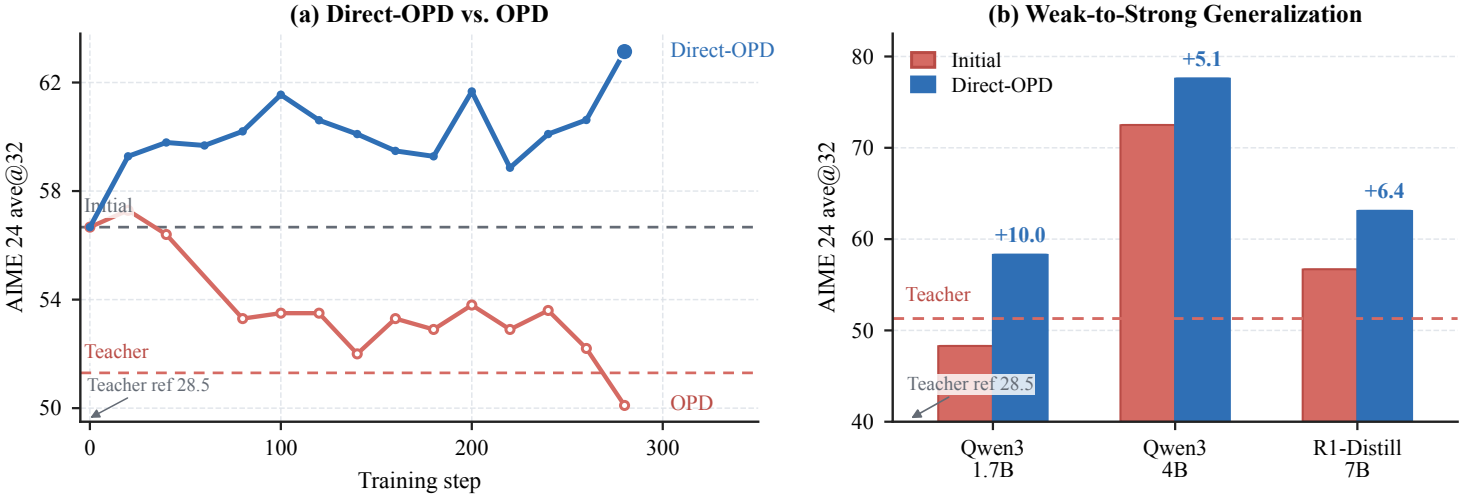
直观地说,这对 checkpoint 告诉我们 RL 让弱模型更愿意或更不愿意采取哪些 action;Direct-OPD 在更强 Student 自己的 on-policy states 上应用该信号,从而直接复用弱模型的 RL supervision,而无需在目标模型上再次运行 sparse-reward RL。实验中,弱 Teacher 一致改善更强模型:Qwen3-1.7B 在 8 张 A100 上训练约 4 小时,AIME 2024 从 48.3% 提升到 58.3%。
Direct-OPD 超过 step-matched direct RL,并支持多个 policy shift 的顺序组合。结果表明,RL 产物可以跨模型规模作为 implicit reward signal 被复用,而不仅是一个等待模仿的最终模型。项目页为 Direct-OPD Project Page。
引言
本节导读:从普通 OPD 在强 Student 上的失败出发,说明为什么 checkpoint pair 的差值才是正确迁移对象。
RLVR 已成为激发 LLM 强推理能力的主流 post-training 方法,但其成本与正在训练的模型直接绑定:每次更新都要求当前 policy 生成 rollout、接受可验证的结果评分,再基于这些轨迹更新。目标模型越大,每条 rollout 越慢,每次 RL iteration 越昂贵;若每个新强模型都从头重跑 RLVR,post-training 会成为扩展推理模型的瓶颈。
本文提出 Direct-OPD 这一 weak-to-strong post-training 范式:把 RL 放在便宜的弱模型上运行,再用这次 RL 学到的内容训练更强目标模型。弱模型不需要比 Student 更会推理;它只是一个低成本载体,负责承载 RL signal 已经重塑的行为。Direct-OPD 转移的是弱模型经过 RL 后发生的改进,而不是弱模型本身。
核心问题在于究竟应从弱 RL run 中转移什么。标准 OPD 让 Student 在自己的 states 上采样,再匹配 post-RL Teacher;但 Teacher 的最终 policy 把 RL 带来的有用变化与弱模型固有能力上限纠缠在一起。当 Student 已强于 Teacher 时,模仿会覆盖掉更强行为。图 1 中,R1-Distill-7B 初始 AIME 2024 为 56.7,已高于 JustRL-1.5B 的 51.3,vanilla OPD 却把它拉到约 50。
\Delta_T(y\mid x)=\log\pi_T(y\mid x)-\log\pi_{T_{\mathrm{ref}}}(y\mid x)公式说明:该式约束的不是 Teacher 绝对输出,而是同一弱模型在 RL 前后的 log-probability 差。它在方法入口处用于构造迁移信号;相减会消除 pre-RL 偏好,减少把弱模型容量限制和原始语言习惯误当作监督的偏差。
其中 π_Tref 是弱模型 RL 前的 reference,π_T 是 post-RL Teacher。Δ_T 对 RL 提高概率的 response 为正,对 RL 抑制的 response 为负。KL-regularized RL 下,这个 shift 与训练弱模型的 reward 在数学上等价到一个正比例和 prompt 常数,因此一对 checkpoint 直接在 policy space 中保存了 RL supervision。Direct-OPD 把它应用于 Student 自己访问的 states,并用 KL 把 Student 锚定到初始化,无需训练显式 reward model。
这种机制把小模型 RL 转换成可迁移 post-training signal。同一 R1-Distill-1.5B→JustRL-1.5B shift 可提升 Qwen3-1.7B、Qwen3-4B 与 R1-Distill-7B,包括初始能力已超过 post-RL Teacher 的 Student。Qwen3-1.7B 用 8 张 A100 约 4 小时从 48.3 提升到 58.3,与 Polaris 在 32 张 A100 上直接对该模型运行至少一周 RL 的结果相当。
论文贡献
第一,提出 weak-to-strong post-training 范式:把小模型 RL 重新理解为更强模型的廉价 implicit reward generator,在 Student 自己的 on-policy states 上评估 Teacher 的 RL-induced policy shift,而非复制弱 Teacher 的最终 policy。
第二,在两个 Teacher pair(R1-Distill-1.5B→JustRL-1.5B、Nemotron-1.5B→QuestA-Nemotron-1.5B)和两个模型家族的三个 Student 上都取得增益,包括已经强于 post-RL Teacher 的 R1-Distill-7B 与 Qwen3-4B。
第三,在匹配 RL steps 时,先对 1.5B 做 RL 再迁移到 7B,在 accuracy 与 compute 上都优于直接对 7B 做 RL。第四,分析信号可靠条件:Direct-OPD 不要求高 Teacher–Student top-k overlap,可以跨 thinking pattern 迁移;response length 与 KL strength 决定 implicit reward 是否可靠。
Direct On-Policy Distillation
本节导读:依次理解标准 OPD、policy-as-reward、Direct-OPD objective、analytical top-k gradient 与 adaptive KL。
Preliminaries: On-Policy Distillation
考虑 autoregressive language-model policy。Prompt x 来自数据分布 D,response y=(y₁,…,y_T),policy 可按 prefix s_t=(x,y_ 标准 OPD 在 Student 自己采样的 trajectory 上监督它。给定 prompt,Student 采样 ŷ;在每个访问 prefix 上读取 Student next-token distribution p_t 与 Teacher distribution q_t,再让 Student 匹配 Teacher。 公式说明:该式约束 Student 的完整 response distribution 接近 post-RL Teacher。它用于 vanilla OPD 基线;误差来自二者 sequence-level distribution mismatch,但在弱到强场景中也可能把 Teacher 的容量上限一并复制。 公式说明:该式把 sequence KL 精确分解为 Student 实际访问 prefix 上的逐 token KL。它在 on-policy rollout 期间提供 dense supervision,减少只用 terminal outcome 时的稀疏 credit-assignment error。 实践中只在 Student top-k support S_t=TopK_v p_t 上查询 Teacher,并把 p_t、q_t 在该集合内重新归一化,从而得到局部估计。 公式说明:该式约束 Student 与 Teacher 在 Student 真正考虑的候选 token 集合上对齐。它降低全 vocabulary scoring 成本,并减少大量极低概率 token 带来的估计噪声;Direct-OPD 保留该 on-policy top-k 接口,只更换从 Teacher 读取的信号。 Direct-OPD 不模仿 Teacher 的绝对输出分布,而是转移 post-RL Teacher 与 pre-RL reference 之间的 sequence-level log-ratio。该量隔离 RL 引起的方向,而非最终 policy。 公式说明:该式约束转移对象为同一个弱模型的 RL 前后变化。它用于从 checkpoint pair 构造 reward-like signal;减去 reference 可减少弱 Teacher 原始偏好、语言风格与容量限制对监督的污染。 这个 shift 不是经验启发式。对 reward r、reference π_ref 和 KL penalty β,KL-regularized RL 的最优解满足 π*∝π_ref exp(r/β)。 公式说明:该式说明最优 policy 与 reference 的 log-ratio 等于 reward 的正比例形式再减 prompt-specific 常数。它用于证明 checkpoint pair 可以反推出 reward;同一 prompt 下常数不影响 response 排序,因而减少显式 reward model 拟合误差。 这也是 DPO 背后的恒等式,但本文反向使用:给定 post-RL policy 与 reference,从 policy ratio 读回 reward-like signal。把 π_T 视为某个 latent reward r_T 在 π_Tref 锚点下的 KL-regularized optimum,可得: 公式说明:该式把 Δ_T 解释成 Teacher reward 的缩放版本。它在 Direct-OPD 的 Student objective 中充当 dense reward;由于只差正比例和 prompt 常数,可保留 action 的改进方向,同时避免重新训练显式 reward model 的建模与过优化误差。 单个 post-RL checkpoint 同时回答‘这个小模型本来喜欢什么’和‘RL 后变得喜欢什么’,二者不可分。Pre/post pair 做差后,前者被抵消,只剩 RL 改变的方向。Teacher 可以整体较弱,但这条方向仍可能在强 Student 的 action space 中有价值。 理想的 sequence-level objective 让 Student 最大化 Teacher shift,同时用 α 加权的 KL 将 Student 约束在自身初始化 π_S 附近。 公式说明:第一项约束 Student 在自己的 rollout 上选择 Teacher RL 所鼓励的 response,第二项限制它不要偏离原始强模型过远。该式用于定义总体训练目标,减少弱信号过度放大导致的 policy drift。 公式说明:最优解等于 Student initialization 乘以 Teacher/reference ratio 的指数倾斜。它说明 Direct-OPD 不是把 Student 变成 π_T,而是在 π_S 上叠加改进方向;α 控制倾斜强度,减少强 Student 原能力被覆盖的风险。 代入 implicit reward 后,π*∝π_S exp(r_T/αβ)。因此 Student 等价于使用小 Teacher 的 implicit reward 执行 KL-regularized RL,但 reference 是它自己的 π_S;整个 reward 来自 checkpoint pair,不需要目标模型访问 verifiable reward 或运行 sparse-reward RL。 由于两个 Teacher 都对同一 prefix 做 autoregressive factorization,sequence shift 可精确分解成 token-level shift。 公式说明:r_t(v)>0 表示弱 Teacher 的 RL 提高了 token v 的概率,r_t(v)<0 表示抑制了它。该式在每个 Student-visited prefix 上提供 immediate reward,减少 terminal reward 无法定位具体 token 的 credit-assignment error。 实现使用 zero-discount token-level surrogate:每个候选 token 只按当前 immediate shift 计分,不累计后续 shift 的 return。这样可以直接复用 on-policy top-k 接口。 在每个访问 prefix 上,算法限制到 Student top-k support,并在该集合内重新归一化 Student probability。 公式说明:该式约束 reward 只作用于 Student 当前真正考虑的 action,并把 top-k 内权重归一。它位于局部 gradient 计算之前,减少 Teacher 在 Student 几乎不会选择的 token 上给出极端 log-ratio 所造成的 off-support noise。 最直接的 single-sample token policy gradient 会用采样 token 的 immediate reward 加权它的 log-likelihood。 公式说明:该式只观察每一步实际采样的 token。它对应 zero-discount surrogate 的朴素估计,但单 token 采样方差高,容易让更新受偶然 token 支配。 由于算法已经获得每个 prefix 上全部 top-k reward 和 probability,可以把单 token 估计替换为 restricted distribution 下的期望,即对每一步 action 做 Rao–Blackwellization,同时仍由 Student 采样整条 trajectory。 公式说明:该式对 top-k 候选全部求和,以 Student probability 作为 weight、Teacher shift 作为 reward。它在 Student trajectory 上训练,但消除每一步 token sampling variance,从而减少 gradient estimator 的方差。 权重 p̄_t(v) 自身依赖 θ;若让梯度穿过它,会引入 top-k softmax 的额外 Jacobian term,使 surrogate 不再对应期望中的 policy-gradient form。因此作者把加权 reward detach 成静态 coefficient。 公式说明:该式阻断 p̄_t(v)r_t(v) 对 θ 的反向传播,只让它作为 log-likelihood 的标量权重。它位于最终 actor loss 中,减少由权重求导额外引入的偏置项。 公式说明:第一项在 Student top-k 上执行 Rao–Blackwellized dense reward update,第二项用 KL 把 actor 锚定到 π_S。它是实际训练的核心,分别减少稀疏 reward 方差与 Student drift;代码中 KL 使用 verl 的标准 penalty 实现。 Δ_T 的 scale 由弱 Teacher 当初的 reward 和 KL budget β 共同决定,但二者无法从 checkpoint pair 中恢复。Student 只决定信号在哪些 prefix 与 top-k action 上被读取。于是固定 α 很难跨 Teacher–Student pair 稳定工作:Δ_T 使用 Teacher reward units,而 α 作用于 Student KL,两者没有先验换算关系。 作者令 α_m 为第 m 次迭代的 KL coefficient,r̄_m 为已访问 prefix 与 top-k candidate 上 Student-weighted shift p̄_t(v)r_t(v) 的 batch mean,并在 actor update 前更新 α。 公式说明:当平均 shift 为正时,α 上升以防局部正信号被过度放大;为负时 α 下降,让 dense gradient 更容易把概率移离 RL 抑制的 token。默认 ε=0.01、α∈[0.5,2.5]。该控制器减少不同 Teacher reward scale 造成的过强或过弱约束误差。 这不同于追踪 target KL 的标准 adaptive controller:更新由 Direct-OPD dense reward 的符号驱动,作用对象是显式 actor KL loss coefficient。目标是把 Student 保持在 Teacher/reference comparison 仍有信息量的 rollout region,而不是机械最大化 dense reward。 二者都让 Student 自己 rollout,也都在 Student top-k token 上读取 Teacher。但普通 OPD 读取 log π_T,目标是像 Teacher;Direct-OPD 读取 log π_T−log π_Tref,目标是在保留 Student 基座的同时沿 RL 改进方向移动。接口相同,监督对象完全不同。\mathcal{L}_{\mathrm{OPD}}(\theta)=\mathbb{E}_{x\sim\mathcal{D}}\left[D_{\mathrm{KL}}\left(\pi_\theta(\cdot\mid x)\,\|\,\pi_T(\cdot\mid x)\right)\right]\mathcal{L}_{\mathrm{OPD}}(\theta)=\mathbb{E}_{x\sim\mathcal{D},\,\hat y\sim\pi_\theta}\left[\sum_{t=1}^{T}D_{\mathrm{KL}}(p_t\,\|\,q_t)\right]\mathcal{L}^{\mathrm{top-}k}_{\mathrm{OPD}}(\theta)=\mathbb{E}_{x\sim\mathcal{D},\,\hat y\sim\pi_\theta}\left[\sum_{t=1}^{T}D_{\mathrm{KL}}\left(\bar p_t^{S_t}\,\|\,\bar q_t^{S_t}\right)\right]Policy Shifts as Implicit Rewards
\Delta_T(y\mid x)=\log\pi_T(y\mid x)-\log\pi_{T_{\mathrm{ref}}}(y\mid x)\log\frac{\pi^*(y\mid x)}{\pi_{\mathrm{ref}}(y\mid x)}=\frac{1}{\beta}r(x,y)-\log Z(x)\Delta_T(y\mid x)=\frac{1}{\beta}r_T(x,y)-\log Z_T(x)关键讲解:为什么两个弱 checkpoint 比一个弱 Teacher 更有用?
The Direct-OPD Objective
J_{\mathrm{Direct\text{-}OPD}}(\theta)=\mathbb{E}_{x\sim\mathcal{D}}\left[\mathbb{E}_{y\sim\pi_\theta}[\Delta_T(y\mid x)]-\alpha D_{\mathrm{KL}}\left(\pi_\theta(\cdot\mid x)\,\|\,\pi_S(\cdot\mid x)\right)\right]\pi^*(y\mid x)\propto\pi_S(y\mid x)\exp\left(\frac{1}{\alpha}\Delta_T(y\mid x)\right)=\pi_S(y\mid x)\left(\frac{\pi_T(y\mid x)}{\pi_{T_{\mathrm{ref}}}(y\mid x)}\right)^{1/\alpha}\Delta_T(y\mid x)=\sum_t r_t(y_t\mid s_t),\qquad r_t(v)=\log\pi_T(v\mid s_t)-\log\pi_{T_{\mathrm{ref}}}(v\mid s_t)Top-k Action Restriction and Analytical Gradient
\bar p_t(v)=\frac{\pi_\theta(v\mid s_t)}{\sum_{u\in S_t}\pi_\theta(u\mid s_t)},\qquad v\in S_t\nabla_\theta J_{\mathrm{MC}}=\mathbb{E}_{x,y}\left[\sum_t r_t(y_t)\nabla_\theta\log\pi_\theta(y_t\mid s_t)\right]\nabla_\theta J_{\mathrm{analytical}}=\mathbb{E}_{x,\,y\sim\pi_\theta}\left[\sum_t\sum_{v\in S_t}\bar p_t(v)r_t(v)\nabla_\theta\log\pi_\theta(v\mid s_t)\right]A_t^{\mathrm{w}}(v)=\operatorname{stop\_gradient}\left(\bar p_t(v)\cdot r_t(v)\right)\nabla_\theta J_{\mathrm{Direct\text{-}OPD}\!}\approx\mathbb{E}_{x\sim\mathcal{D},\,y\sim\pi_\theta}\left[\sum_t\sum_{v\in S_t}A_t^{\mathrm{w}}(v)\nabla_\theta\log\pi_\theta(v\mid s_t)\right]-\alpha\nabla_\theta D_{\mathrm{KL}}\left(\pi_\theta(\cdot\mid x)\,\|\,\pi_S(\cdot\mid x)\right)Adaptive KL Control
\alpha_{m+1}=\operatorname{clip}\left(\alpha_m\left(1+\epsilon\,\operatorname{sgn}(\bar r_m)\right),\alpha_{\min},\alpha_{\max}\right)关键讲解:Direct-OPD 与普通 OPD 的差别
实验
本节导读:回答弱 Teacher 能否改善强 Student、是否优于大模型直接 RL,以及多个 shift 能否顺序组合。
实验回答三个研究问题。RQ1:小 Teacher 的 RL-induced shift 能否改善已经达到或超过 Teacher 的 Student,并跨 Teacher pair 与 Student family 成立?RQ2:固定 RL-step budget 下,在小模型上运行 RL 后迁移,能否在 accuracy 和 compute 上超过直接训练大模型?RQ3:多个独立 policy shift 能否顺序组合并在同一个 Student 中累积收益?
RQ1:小 RL Teacher 改善更强 Student
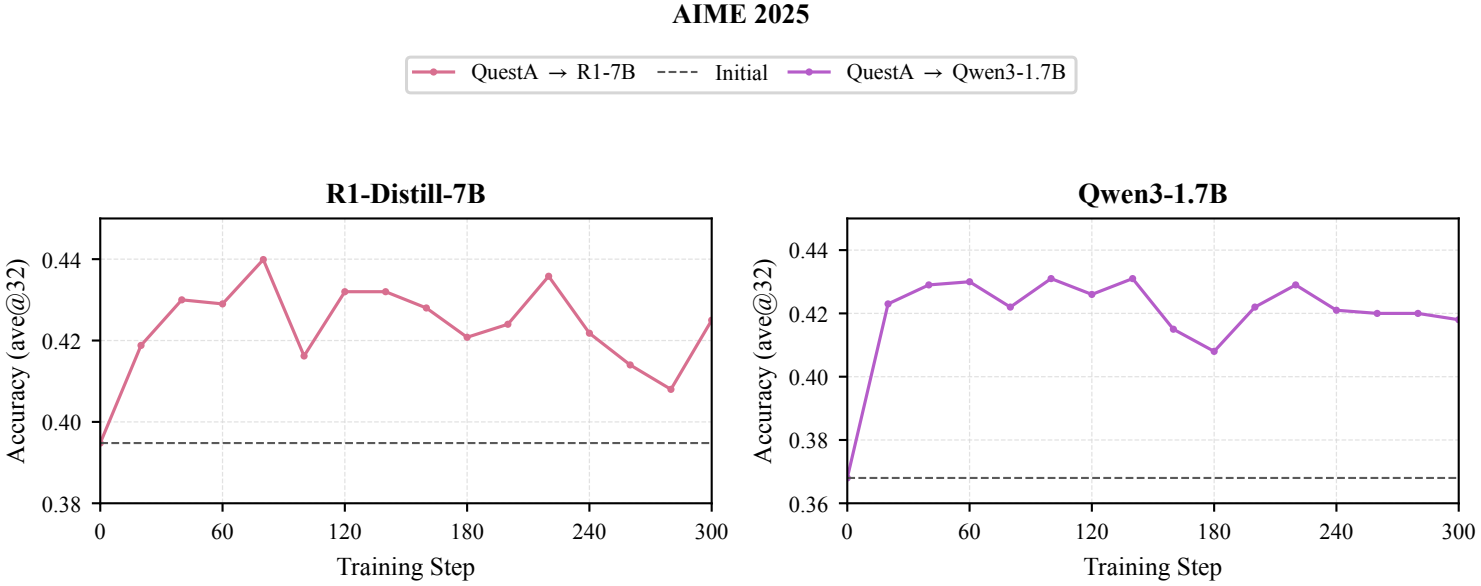
第一组 Teacher pair 是 R1-Distill-1.5B reference 与 JustRL-1.5B post-RL Teacher,policy shift 被迁移到 R1-Distill-7B、Qwen3-1.7B 和 Qwen3-4B。R1-Distill-7B 与 Qwen3-4B 在迁移前已超过 JustRL Teacher,因此构成直接 weak-to-strong test。
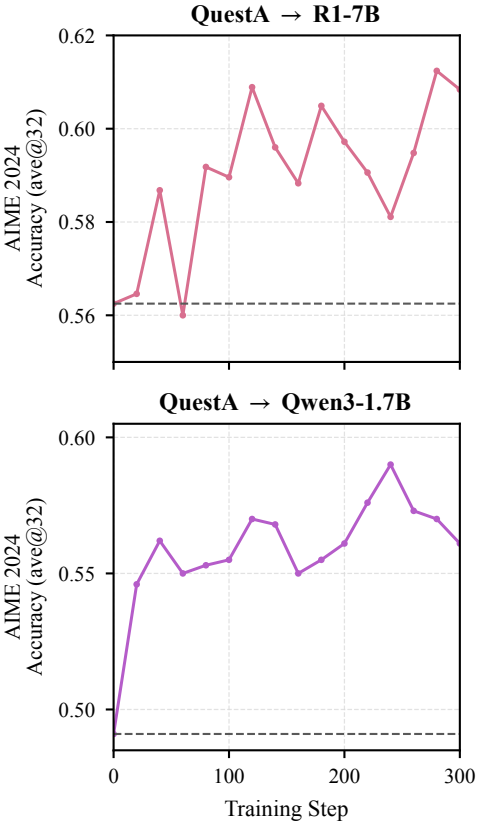
第二组是 Nemotron-1.5B→QuestA-Nemotron-1.5B,来自不同训练 pipeline 和 data source。由于 QuestA Teacher 在 AIME 上本身较强,这组不是严格弱 Teacher 对强 Student;它用来检验 Direct-OPD 是否能跨 Teacher family、训练 recipe 与数据来源迁移。目标 Student 为 R1-Distill-7B 与 Qwen3-1.7B。
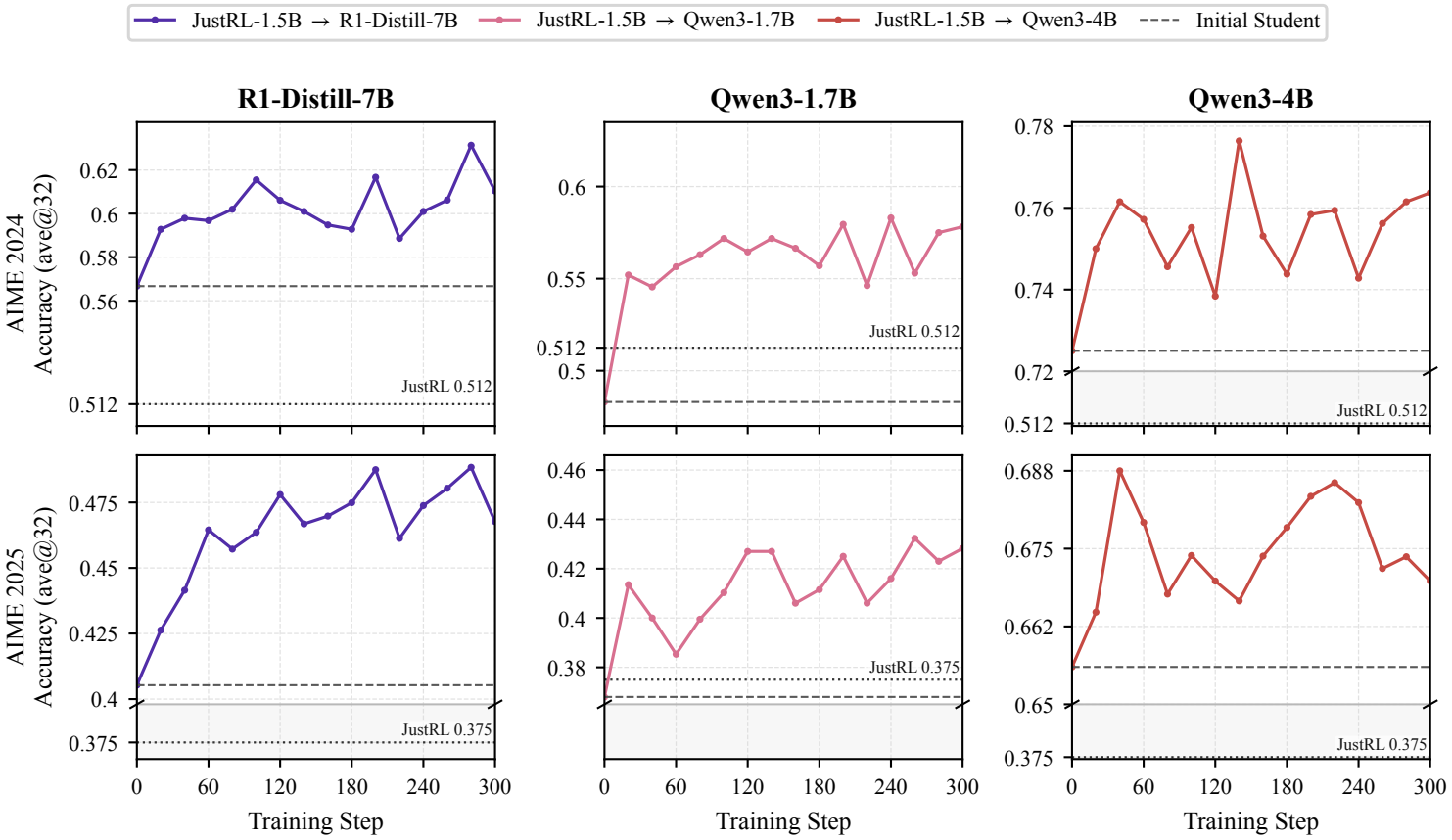
| JustRL shift | AIME24 | AIME25 |
|---|---|---|
| Teacher ref | 28.5 | 24.0 |
| Teacher RL | 51.3 | 37.5 |
| Qwen3-1.7B | 48.3 | 36.8 |
| + Direct-OPD | 58.3 (+10.0) | 43.2 (+6.4) |
| Qwen3-4B | 72.5 | 65.6 |
| + Direct-OPD | 77.6 (+5.1) | 68.8 (+3.2) |
| R1-Distill-7B | 56.7 | 40.5 |
| + Direct-OPD | 63.1 (+6.4) | 48.8 (+8.3) |
| QuestA shift | AIME24 | AIME25 |
|---|---|---|
| Teacher ref | 61.77 | 49.50 |
| Teacher RL | 72.50 | 62.29 |
| Qwen3-1.7B | 48.3 | 36.8 |
| + Direct-OPD | 59.0 (+10.7) | 43.1 (+6.3) |
| R1-Distill-7B | 56.3 | 39.5 |
| + Direct-OPD | 61.2 (+4.9) | 44.0 (+4.5) |
这些结果支持 policy-shift interpretation:Direct-OPD 使用 RL 学到的改进方向,而非 Teacher 全 policy。特别是 Student 起始分数高于 Teacher 时仍提升,排除了‘只是复制更强答案分布’这一解释。
RQ2:Weak-to-Strong 路径超过直接 RL
作者比较两条匹配 RL steps 的路线。Direct-RL route 直接对 R1-Distill-7B 做 RL;weak-to-strong route 先对 R1-Distill-1.5B 做 RL,再用 Direct-OPD 把 RL/reference shift 迁移到 7B。
小模型在 DAPO dataset 上训练,选取 step 300、600、900、1200、1500 checkpoint,每个 checkpoint 与 base R1-Distill-1.5B 组成 Teacher pair。T300 表示小模型先做 300 steps RL 再迁移;T600–T1500 类推。最终将 7B validation score 与相同小 Teacher RL step 对应的 direct 7B RL 比较。
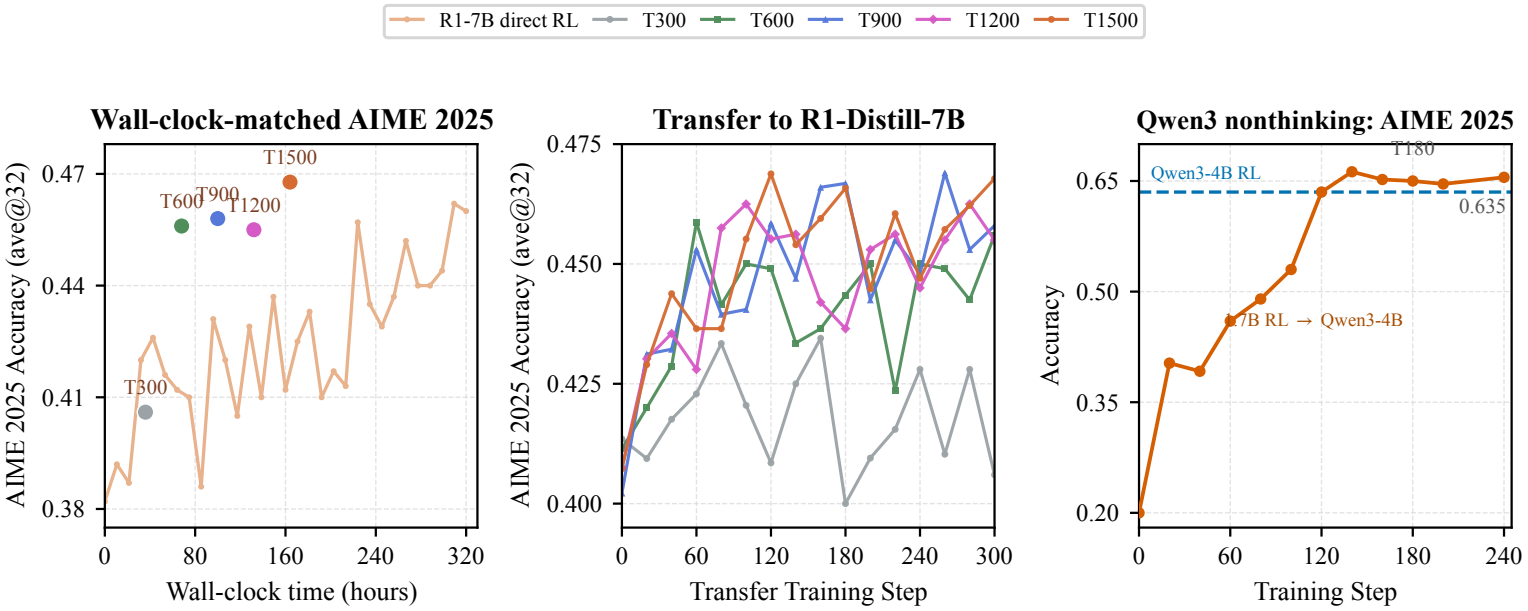
同样 RL step 数下,小模型 RL 后迁移到大模型,比直接在 7B 上运行 RL 得到更高性能。1500-step R1-Distill-1.5B RL 约需 32 张 A100 × 160 小时,7B RL 约需 32 张 A100 × 320 小时;随后 Direct-OPD 仅增加 8 张 A100 × 约 4 小时。迁移成本低,是因为训练 run 很短,且用于 scoring 的两个 Teacher 都很小。
转移信号依赖所选小模型 RL checkpoint:RL trajectory 不同位置编码不同 shift,并非每条 shift 在大 Student state distribution 上都同样有用。小模型的作用不是提供比 7B 更强的 endpoint,而是作为更便宜的环境,让 RL 先发现改进方向;Direct-OPD 在大模型自己的 states 上重新评估该方向。
Qwen3 nonthinking model 上也出现相同模式:对 1.7B 做 100-step RL 后,将 shift 迁移到 Qwen3-4B-nonthinking,可在 AIME 2025 达到 direct 4B RL 的 0.635 accuracy。
实验结论:为什么这条路线更省
Direct RL 要让 7B 自己生成昂贵 rollout 并发现方向;weak-to-strong route 让 1.5B 完成探索,再用 dense token signal 做一次短迁移。省掉的是大模型反复探索和 sparse credit assignment 的成本,而不是完全省掉训练。
RQ3:Sequential Composition
最后,作者测试两条独立 policy shift 能否顺序作用于同一个 Student。Qwen3-1.7B 先使用 R1-Distill-1.5B→JustRL-1.5B signal 训练,再从该 checkpoint 继续使用 Nemotron-1.5B→QuestA-Nemotron-1.5B signal。第二阶段本地 0–300 steps 对齐到 global 300–600 steps;阶段边界两次评测使用独立 sample,轻微跳变来自 evaluation variance。
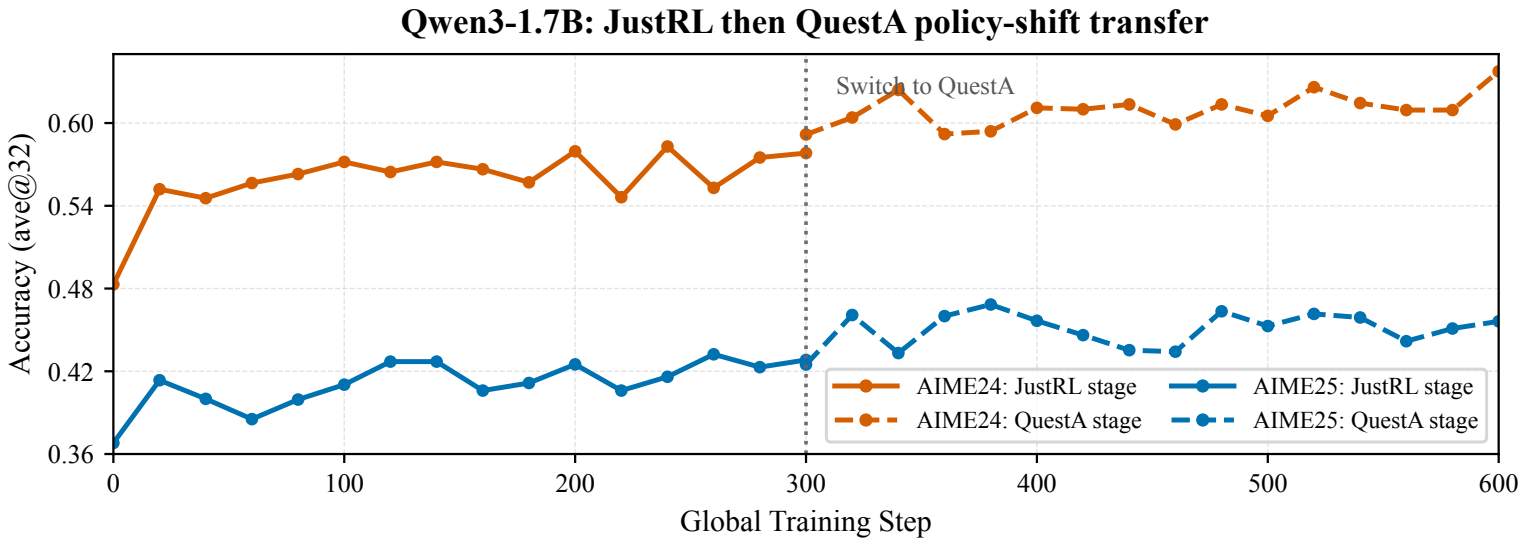
| Stage | AIME24 | AIME25 |
|---|---|---|
| Initial | 48.3 | 36.8 |
| After JustRL | 58.3 (+10.0) | 43.2 (+6.4) |
| After QuestA | 63.8 (+15.5) | 46.8 (+10.0) |
Analysis and Training Dynamics
本节导读:分析 transfer 的载体、short-horizon generalization 和 KL 对 reward reliability 的影响。
上一节说明 Direct-OPD 能进行 weak-to-strong transfer;本节分析它何时、为何有效,关注三点:是否必须模仿 Teacher 的高概率 token;2k-token short-horizon training 是否能改变更长 rollout;以及 KL coefficient 如何控制 Teacher-shift reward 的可靠性。
Cross-Pattern Transfer Without Token-Overlap Imitation
标准 OPD 研究认为 Teacher–Student thinking pattern compatibility 是关键条件:成功蒸馏通常表现为 Student-visited states 上高概率 token 逐步对齐,一小组共享 top-k token 承载大部分 probability mass。这对模仿 Teacher 最终分布很自然,因为提高 overlap 本身就是监督传播路径。
作者使用既有 OPD 工作的 set-overlap metric。对 Student policy π_S 和 comparison policy π_C,在 state s_t 上分别取 top-k token set。
T_k^S(s_t)=\operatorname{TopK}_{v}\pi_S(v\mid s_t),\qquad T_k^C(s_t)=\operatorname{TopK}_{v}\pi_C(v\mid s_t)公式说明:该式定义后续 overlap diagnostic 的两个候选集合。它用于训练动态分析而非优化;通过只比较高概率 token,减少尾部 vocabulary 对 thinking-pattern similarity 的测量噪声。
\operatorname{Overlap}_k(S,C;s_t)=\frac{|T_k^S(s_t)\cap T_k^C(s_t)|}{k}公式说明:该式计算两个 top-k 集合交集占 k 的比例。它在相同 Student-visited states 上分别对 post-RL Teacher 和 Teacher reference 计算,用来判断性能提升是否来自逐步模仿任一 checkpoint;集合归一化减少不同序列长度对指标的影响。
Direct-OPD 改变了转移对象:它不匹配 post-RL distribution,而是在 Student 自己的 support 内对 candidate token 读取 Teacher/reference log-ratio。这条信号可以在 Student action space 内重新排序,因此有用迁移不要求 Student 进入 Teacher 的高-overlap regime。
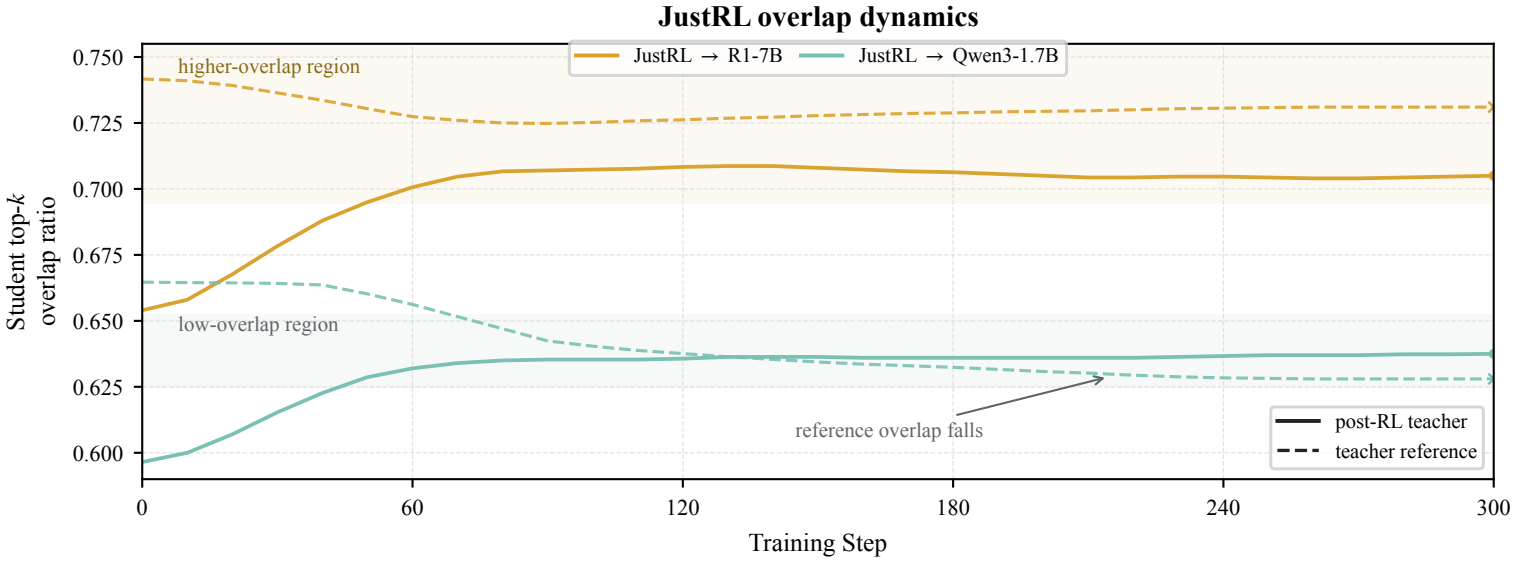
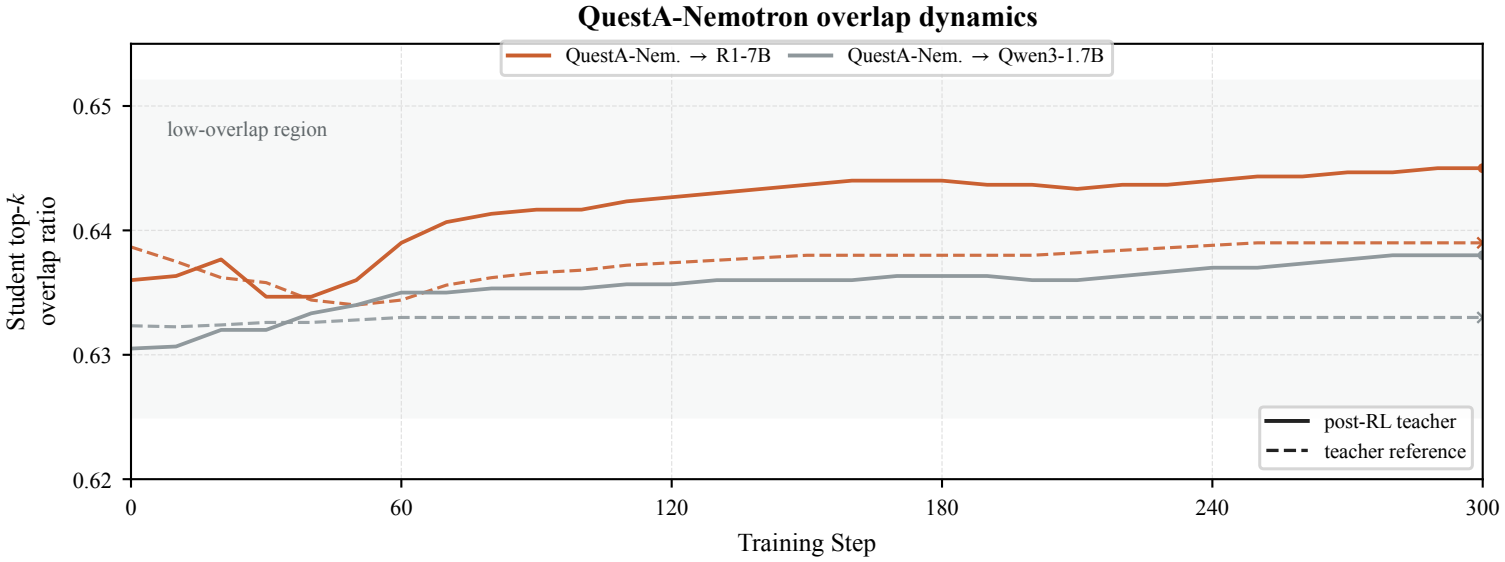
Aligned case 会进入更高 post-RL overlap;cross-pattern case 则与 post-RL Teacher overlap 保持较低,与 reference overlap 也没有补偿性上升。因此图 2 的增益更符合‘在 Student 自己访问的 states 上使用 reference→post-RL direction’,而不是模仿某个 Teacher。
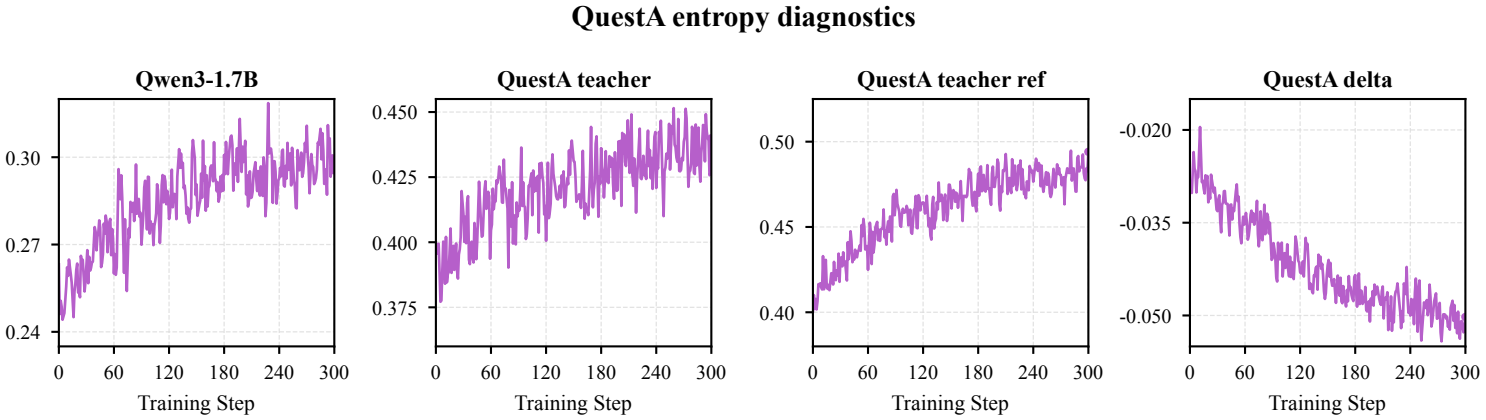
作者进一步检查低 overlap 是否只是 degenerate sharpening。如果 Direct-OPD 让 actor collapse 成低 entropy distribution,overlap 结论就不可靠。
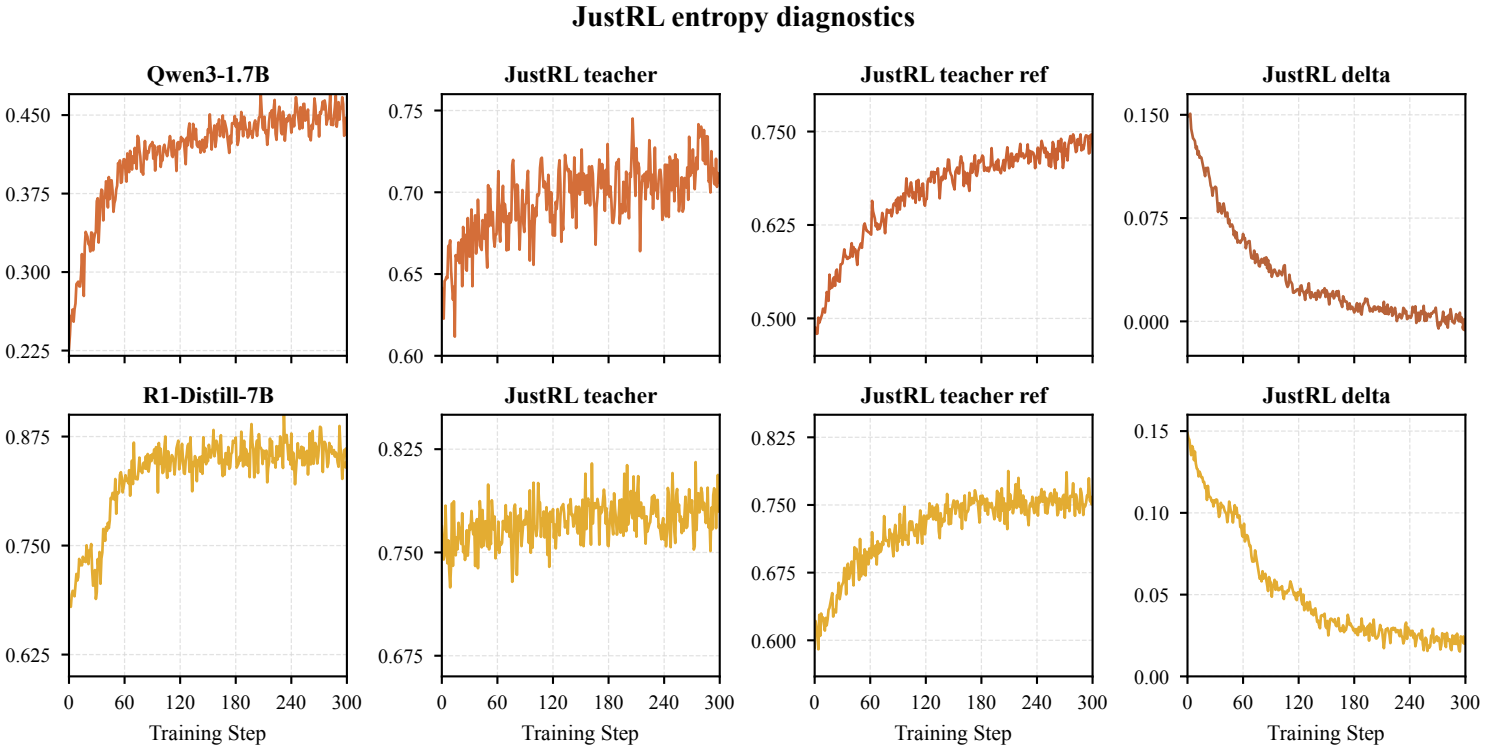
本节结论
Direct-OPD 不要求 token-overlap 持续升高。只要 Teacher shift 能在 Student 当前 top-k action 中提供相对排序,即使二者 thinking pattern 不同,也能迁移改进方向。
Short-Horizon Training Changes Longer Rollouts
受 on-policy prefix distillation 启发,作者训练时故意只使用 2k-token response horizon,但测试时允许长生成,检验 policy change 是否超出直接监督 prefix。自然担忧是短训练只改变 early prefix,后续推理行为保持不变。
为直接测量长 rollout 行为,作者在固定长序列的每个 prefix x_≤t 上取 actor top-16 set K_t,计算 actor-probability-weighted Teacher gap。
g_t=\sum_{a\in K_t}\pi_{\mathrm{actor}}(a\mid x_{\le t})\left[\log\pi_{\mathrm{JustRL}}(a\mid x_{\le t})-\log\pi_{\mathrm{R1}}(a\mid x_{\le t})\right]公式说明:该式衡量 actor 当前偏好的 token 在 JustRL 相对 R1 reference 下得到多少 log-probability 增益。它用于 long-rollout diagnostic;用 actor probability 加权可减少不太可能 action 对指标的干扰。
G_T=\sum_{t=1}^{T}g_t公式说明:该式把每个位置的 gap 累加到长度 T。更大的 G_T 表示 actor likely tokens 更像 post-RL direction,更小则更接近 reference;它用于判断 2k 训练是否影响远超 2k 的位置,减少仅观察 early prefix 的测量盲区。
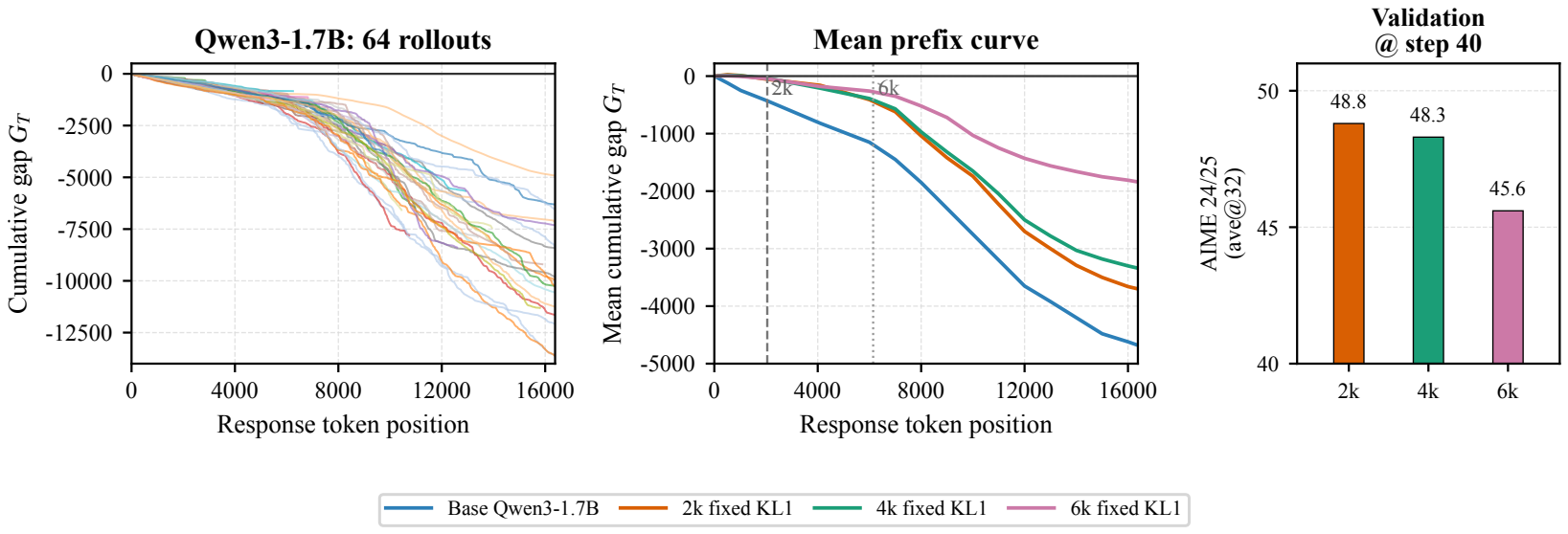
40 steps、2k response 后,actor 沿更长固定 rollout 都朝 Teacher-shift direction 移动。6k 在 diagnostic 上移动得更远,却以 45.6 低于 2k 的 48.8;一种解释是 late prefix 上小 Teacher pair 越来越 off-distribution,log-ratio 大但不可靠。6k 会过度驱动 actor,2k 避开噪声却已捕获并泛化可靠 early-prefix direction。
本节结论
Short-horizon Direct-OPD 可以改变更长 reasoning trajectory。Moderate response length 在信号覆盖与 late-prefix noise 之间取得平衡;训练 horizon 不是越长越好。
KL Controls Reward Reliability
Teacher/reference log-ratio 只有在 Teacher shift 对 Student 所访问 state 有意义时才是可靠 dense reward。因此 KL 不只是常规 regularization coefficient,它还控制 Student 去哪些 rollout states,从而决定 reward 是否仍可信。KL 太弱,Student 会漂到 Teacher 与 reference 都给低概率的区域,log-ratio 成为 noisy target;KL 太强,Student 又无法跟随 policy shift。
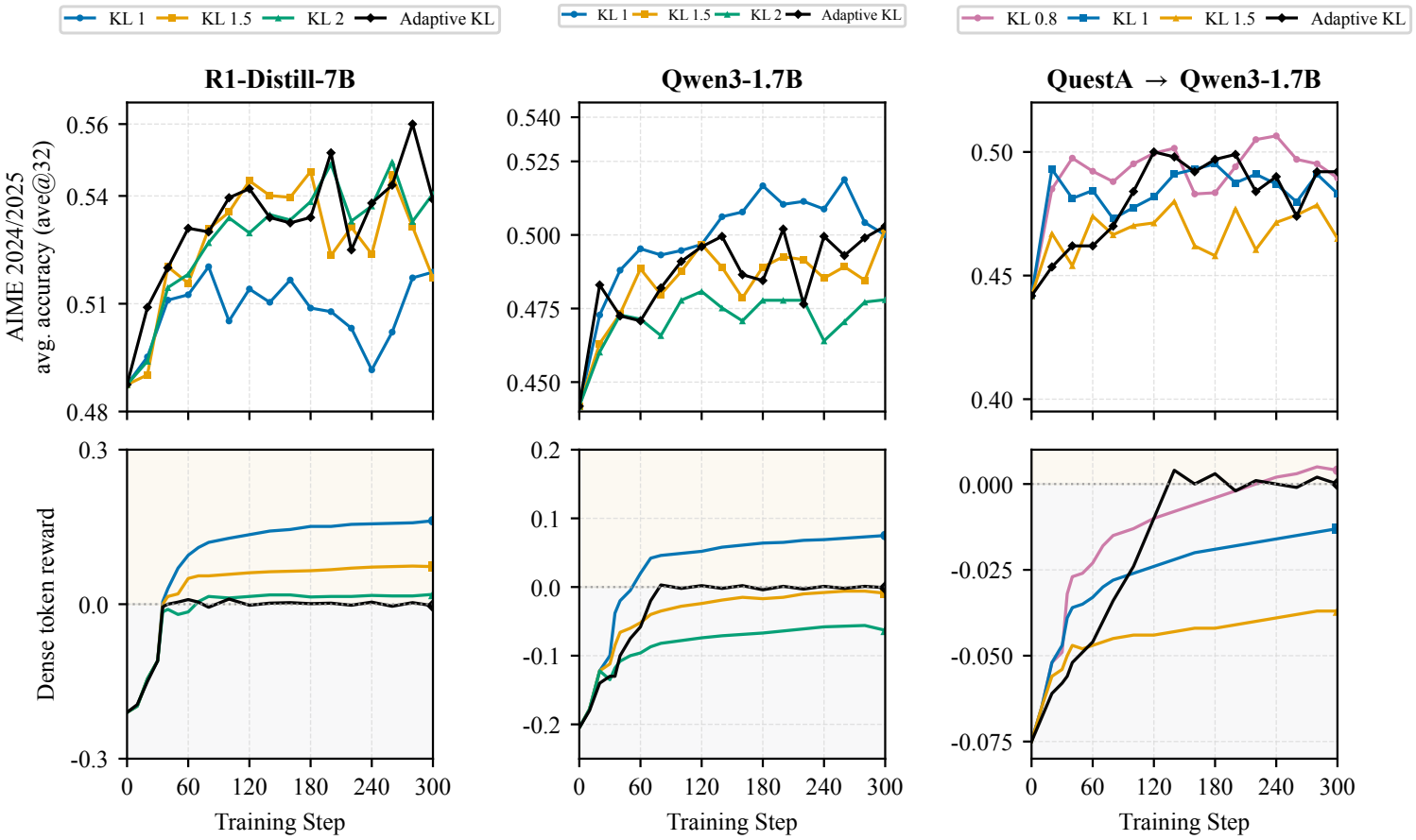
Fixed-KL sweep 表明不存在通用最佳值;dense reward 也没有跨 pair 通用的单调规则。在一个设置中更大的正 reward 可能伴随更差 validation,在另一个设置中却追随最佳曲线。因此 reward 必须结合 rollout distribution 解读,不能脱离 Student 当前采样区域单独最大化。
Adaptive-KL run 在初始修正后让 mean dense reward 接近零。持续大 reward 可能意味着 Student 正在采样 Teacher 与 reference 强烈分歧、但两者都低 support 的 token,此时 log-ratio 数值大却不再是可信改进方向。接近零的 batch mean 代表更平衡的 regime:局部 token shift 仍可排序 action,但没有整体漂移。
本节结论
Direct-OPD 的 reward 是 rollout-distribution dependent。Adaptive KL 的目标不是追逐最大 reward,而是把 Student 留在 checkpoint pair 的比较仍有信息量的区域。
结论与局限
本节导读:总结论文已证明的结论,并区分仍需验证的外推范围。
Direct-OPD 表明,小 RL Teacher 学到的 policy shift 可以作为 weak-to-strong generalization 的有效 dense reward。可迁移对象不是 post-RL Teacher policy,而是它相对 pre-RL reference 的 log-ratio,并在 Student-visited token 上评估;这解释了为什么更小、更弱的 Teacher 仍能改善强 Student。
实验显示该方向可跨 Teacher pair 与 Student family 迁移,以更低 compute 超过 step-matched direct RL,并可顺序组合多个 Teacher shift。论文因此把 RL outcome 重新理解为可复用 improvement signal,而不是只能模仿的最终模型。
局限 1:信号具有条件性
当 Teacher/reference improvement 在 Student-visited states 上没有意义时,Direct-OPD 会失败。Checkpoint pair 并不会自动保证所有 Student distribution 上的 log-ratio 都可靠。
局限 2:超参数依赖 Pair
最佳 response length 与 KL strength 仍依赖 Teacher–Student pair。Adaptive KL 能缓解 scale mismatch,但没有消除 pair-specific tuning 和 checkpoint selection。
批判性阅读
论文在 AIME 数学推理上给出了清晰机制与计算对比,但 benchmark、Teacher pair 和 Student family 仍相对集中。迁移到 code、agentic task、open-ended reward 或更大模型时,Teacher shift 是否保持可靠仍需验证。
附录:实验细节与补充结果
本节导读:保留训练 prompt、evaluation protocol、Direct-OPD/RL 超参数和两组补充图。
Appendix A:Experimental Details
最终 Direct-OPD run 使用 Skywork-OR1-RL-Data 的 math subset,并采用 DAPO-style math prompt。Prompt 要求逐步解题,最后一行单独写成 ‘Answer: $Answer’。该模板同时用于训练 rollout 与 evaluation。
Solve the following math problem step by step.
The last line of your response should be of the form
Answer: $Answer (without quotes) where $Answer is the answer to the problem.

{Question}

Remember to put your answer on its own line after "Answer:".
该 prompt 不同于 Teacher RL 使用的 boxed-answer prompt;实验中 DAPO-style prompt 略微提升迁移。作者没有把 prompt-template divergence 作为研究重点,因此统一采用该设置。将 Skywork training data 换成 DAPO-Math-17K 且保持 prompt 不变时也观察到类似趋势,说明结果并非依赖单一训练集。
Evaluation Protocol
| Evaluation setting | Value |
|---|---|
| Benchmarks | AIME 2024, AIME 2025 |
| Samples per problem | 32 |
| Sampling temperature | 0.7 |
| Top-p | 0.95 |
| Maximum generation length | 31,744 |
Direct-OPD Training Hyperparameters
| Hyperparameter | Value |
|---|---|
| Training framework | verl |
| Global / mini batch size | 64 / 64 |
| Rollout n | 4 |
| Maximum prompt / response length | 1,024 / 2,048 |
| Sampling temperature / top-p | 1.0 / 1.0 |
| Learning rate | 1×10⁻⁶ |
| Training steps | 300 |
| Fixed KL coefficient | 0.8–2,随 pair 调整 |
| Student top-k support | 16 |
| Top-k strategy | Student top-k |
RL Teacher and Baseline Settings
Teacher construction 与 direct-RL baseline 都使用 GRPO。R1-Distill-1.5B/7B 的 train batch size 为 512,Qwen3-1.7B/4B-nonthinking 为 128;PPO mini batch size 均为 128,rollout n=8,maximum prompt/response length=2,048/16,384,temperature=1.0,learning rate=1×10⁻⁶,KL coefficient=0。R1 run 另外使用 clip high=0.28、clip low=0.2。
| Model group | Train batch | PPO mini batch | Rollout n | Max response | KL |
|---|---|---|---|---|---|
| R1-Distill-1.5B / 7B | 512 | 128 | 8 | 16,384 | 0.0 |
| Qwen3-1.7B / 4B nonthinking | 128 | 128 | 8 | 16,384 | 0.0 |
Appendix B:Additional Entropy Diagnostics
Appendix C:Additional Results
参考文献
本节导读:保留源码中实际引用的英文 bibliographic entries。
参考文献保留英文题名和原始 bibliographic 信息,不翻译文献条目。以下仅列出正文与附录实际引用的文献,并按论文首次引用顺序排列。
- DeepSeek-AI; Guo, Daya; Yang, Dejian; Zhang, Haowei; Song, Junxiao; Wang, Peiyi; Zhu, Qihao; Xu, Runxin; Zhang, Ruoyu; Ma, Shirong; Bi, Xiao; others (2025). DeepSeek-R1: Incentivizing Reasoning Capability in LLMs via Reinforcement Learning. Nature.
- Shao, Zhihong; Wang, Peiyi; Zhu, Qihao; Xu, Runxin; Song, Junxiao; Bi, Xiao; Zhang, Haowei; Zhang, Mingchuan; Li, Y. K.; Wu, Y.; Guo, Daya (2024). DeepSeekMath: Pushing the Limits of Mathematical Reasoning in Open Language Models. arXiv preprint arXiv:2402.03300.
- Schulman, John; Wolski, Filip; Dhariwal, Prafulla; Radford, Alec; Klimov, Oleg (2017). Proximal Policy Optimization Algorithms. arXiv preprint arXiv:1707.06347.
- Kimi Team (2025). Kimi k1.5: Scaling Reinforcement Learning with LLMs. arXiv preprint arXiv:2501.12599.
- Qwen Team (2025). QwQ-32B: Embracing the Power of Reinforcement Learning. https://qwenlm.github.io/blog/qwq-32b/.
- Hu, Jingcheng; Zhang, Yinmin; Han, Qi; Jiang, Daxin; Zhang, Xiangyu; Shum, Heung-Yeung (2025). Open-Reasoner-Zero: An Open Source Approach to Scaling Reinforcement Learning on the Base Model. https://github.com/Open-Reasoner-Zero/Open-Reasoner-Zero.
- Yu, Qiying; Zhang, Zheng; Zhu, Ruofei; Yuan, Yufeng; Zuo, Xiaochen; Yue, Yu; Fan, Tiantian; Liu, Gaohong; Liu, Lingjun; Liu, Xin; others (2025). DAPO: An Open-Source LLM Reinforcement Learning System at Scale. arXiv preprint arXiv:2503.14476.
- He, Bingxiang; Qu, Zekai; Liu, Zeyuan; Chen, Yinghao; Zuo, Yuxin; Qian, Cheng; Zhang, Kaiyan; Chen, Weize; Xiao, Chaojun; Cui, Ganqu; Ding, Ning; Liu, Zhiyuan (2025). JustRL: Scaling a 1.5B LLM with a Simple RL Recipe. arXiv preprint arXiv:2512.16649.
- An, Chenxin; others (2025). POLARIS: A Post-Training Recipe for Scaling Reinforcement Learning on Reasoning Models. https://github.com/ChenxinAn-fdu/POLARIS.
- Li, Jiazheng; Lin, Hongzhou; Lu, Hong; Wen, Kaiyue; Yang, Zaiwen; Gao, Jiaxuan; Wu, Yi; Zhang, Jingzhao (2025). QuestA: Expanding Reasoning Capacity in LLMs via Question Augmentation. arXiv preprint arXiv:2507.13266.
- Jujie He; Jiacai Liu; Chris~Yuhao Liu; Rui Yan; Chaojie Wang; Peng Cheng; Xiaoyu Zhang; Fuxiang Zhang; Jiacheng Xu; Wei Shen; others (2025). Skywork open reasoner 1 technical report. arXiv preprint arXiv:2505.22312.
- Zhiwei He; Tian Liang; Jiahao Xu; Qiuzhi Liu; Xingyu Chen; Yue Wang; Linfeng Song; Dian Yu; Zhenwen Liang; Wenxuan Wang; others (2025). Deepmath-103k: A large-scale, challenging, decontaminated, and verifiable mathematical dataset for advancing reasoning. arXiv preprint arXiv:2504.11456.
- Bingxiang He; Yuxin Zuo; Zeyuan Liu; Shangziqi Zhao; Zixuan Fu; Junlin Yang; Cheng Qian; Kaiyan Zhang; Yuchen Fan; Ganqu Cui; others (2026). How far can unsupervised rlvr scale llm training?. arXiv preprint arXiv:2603.08660.
- Yang, An; Li, Anfeng; Yang, Baosong; Zhang, Beichen; Hui, Binyuan; Zheng, Bo; Yu, Bowen; Gao, Chang; Huang, Chengen; Lv, Chenxu; others (2025). Qwen3 Technical Report. arXiv preprint arXiv:2505.09388.
- DeepSeek-AI (2026). DeepSeek V4 Preview Release. https://api-docs.deepseek.com/news/news260424.
- Z.ai (2026). GLM-5.2: Built for Long-Horizon Tasks. https://z.ai/blog/glm-5.2.
- Moshkov, Ivan; Hanley, Darragh; Sorokin, Ivan; Toshniwal, Shubham; Henkel, Christof; Schifferer, Benedikt; Du, Wei; Gitman, Igor (2025). AIMO-2 Winning Solution: Building State-of-the-Art Mathematical Reasoning Models with OpenMathReasoning Dataset. arXiv preprint arXiv:2504.16891.
- Etash Guha; Ryan Marten; Sedrick Keh; Negin Raoof; Georgios Smyrnis; Hritik Bansal; Marianna Nezhurina; Jean Mercat; Trung Vu; Zayne Sprague; others (2025). Openthoughts: Data recipes for reasoning models. arXiv preprint arXiv:2506.04178.
- Jia Li; Edward Beeching; Lewis Tunstall; Ben Lipkin; Roman Soletskyi; Shengyi Huang; Kashif Rasul; Longhui Yu; Albert~Q Jiang; Ziju Shen; others (2024). Numinamath: The largest public dataset in ai4maths with 860k pairs of competition math problems and solutions.
- Geoffrey Hinton; Oriol Vinyals; Jeff Dean (2015). Distilling the knowledge in a neural network. arXiv preprint arXiv:1503.02531.
- Kim, Yoon; Rush, Alexander M (2016). Sequence-Level Knowledge Distillation. Proceedings of EMNLP.
- Victor Sanh; Lysandre Debut; Julien Chaumond; Thomas Wolf (2019). Distilbert, a distilled version of bert: smaller, faster, cheaper and lighter. arXiv preprint arXiv:1910.01108.
- Xiaoqi Jiao; Yichun Yin; Lifeng Shang; Xin Jiang; Xiao Chen; Linlin Li; Fang Wang; Qun Liu (2020). Tinybert: Distilling bert for natural language understanding.
- Wenhui Wang; Furu Wei; Li~Dong; Hangbo Bao; Nan Yang; Ming Zhou (2020). Minilm: Deep self-attention distillation for task-agnostic compression of pre-trained transformers.
- Seyed~Iman Mirzadeh; Mehrdad Farajtabar; Ang Li; Nir Levine; Akihiro Matsukawa; Hassan Ghasemzadeh (2020). Improved knowledge distillation via teacher assistant.
- Jang~Hyun Cho; Bharath Hariharan (2019). On the efficacy of knowledge distillation.
- Busbridge, Dan; Shidani, Amitis; Weers, Floris; Ramapuram, Jason; Littwin, Etai; Webb, Russ (2025). Distillation Scaling Laws. arXiv preprint arXiv:2502.08606.
- Gu, Yuxian; Dong, Li; Wei, Furu; Huang, Minlie (2023). MiniLLM: Knowledge Distillation of Large Language Models. arXiv preprint arXiv:2306.08543.
- Yuqiao Wen; Zichao Li; Wenyu Du; Lili Mou (2023). f-Divergence Minimization for Sequence-Level Knowledge Distillation. Proceedings of ACL.
- Qihuang Zhong; Liang Ding; Li Shen; Juhua Liu; Bo Du; Dacheng Tao (2024). Revisiting Knowledge Distillation for Autoregressive Language Models. Proceedings of ACL.
- Taiqiang Wu; Chaofan Tao; Jiahao Wang; Runming Yang; Zhe Zhao; Ngai Wong (2025). Rethinking Kullback-Leibler Divergence in Knowledge Distillation for Large Language Models. Proceedings of COLING.
- Jongwoo Ko; Sungnyun Kim; Tianyi Chen; Se-Young Yun (2024). DistiLLM: Towards Streamlined Distillation for Large Language Models. Proceedings of ICML.
- Jongwoo Ko; Tianyi Chen; Sungnyun Kim; Tianyu Ding; Luming Liang; Ilya Zharkov; Se-Young Yun (2025). DistiLLM-2: A Contrastive Approach Boosts the Distillation of LLMs. Proceedings of ICML.
- Yuxian Gu; Hao Zhou; Fandong Meng; Jie Zhou; Minlie Huang (2025). MiniPLM: Knowledge Distillation for Pre-Training Language Models. Proceedings of ICLR.
- Yongchao Zhou; Kaifeng Lyu; Ankit Singh Rawat; Aditya Krishna Menon; Afshin Rostamizadeh; Sanjiv Kumar; Jean-Fran\ccois Kagy; Rishabh Agarwal (2024). DistillSpec: Improving Speculative Decoding via Knowledge Distillation. Proceedings of ICLR.
- Wenda Xu; Rujun Han; Zifeng Wang; Long T. Le; Dhruv Madeka; Lei Li; William Yang Wang; Rishabh Agarwal; Chen-Yu Lee; Tomas Pfister (2025). Speculative Knowledge Distillation: Bridging the Teacher-Student Gap Through Interleaved Sampling. Proceedings of ICLR.
- Agarwal, Rishabh; Vieillard, Nino; Zhou, Yongchao; Stanczyk, Piotr; Ramos, Sabela; Geist, Matthieu; Bachem, Olivier (2023). On-Policy Distillation of Language Models: Learning from Self-Generated Mistakes. arXiv preprint arXiv:2306.13649.
- Kevin Lu; Thinking~Machines Lab (2025). On-policy distillation.
- Li, Yaxuan; Zuo, Yuxin; He, Bingxiang; Zhang, Jinqian; Xiao, Chaojun; Qian, Cheng; Yu, Tianyu; Gao, Huan-ang; Yang, Wenkai; Liu, Zhiyuan; Ding, Ning (2026). Rethinking On-Policy Distillation of Large Language Models: Phenomenology, Mechanism, and Recipe. arXiv preprint arXiv:2604.13016.
- Song, Mingyang; Zheng, Mao (2026). A Survey of On-Policy Distillation for Large Language Models. arXiv preprint arXiv:2604.00626.
- Yuqian Fu; Haohuan Huang; Kaiwen Jiang; Yuanheng Zhu; Dongbin Zhao (2026). Revisiting on-policy distillation: Empirical failure modes and simple fixes. arXiv preprint arXiv:2603.25562.
- Woogyeol Jin; Taywon Min; Yongjin Yang; Swanand~Ravindra Kadhe; Yi~Zhou; Dennis Wei; Nathalie Baracaldo; Kimin Lee (2026). Entropy-aware on-policy distillation of language models. arXiv preprint arXiv:2603.07079.
- Ijun Jang; Jewon Yeom; Juan Yeo; Hyunggu Lim; Taesup Kim (2026). Stable on-policy distillation through adaptive target reformulation. arXiv preprint arXiv:2601.07155.
- Gengsheng Li; Tianyu Yang; Junfeng Fang; Mingyang Song; Mao Zheng; Haiyun Guo; Dan Zhang; Jinqiao Wang; Tat-Seng Chua (2026). Unifying group-relative and self-distillation policy optimization via sample routing. arXiv preprint arXiv:2604.02288.
- Tianzhu Ye; Li~Dong; Xun Wu; Shaohan Huang; Furu Wei (2026). On-policy context distillation for language models. arXiv preprint arXiv:2602.12275.
- Tianzhu Ye; Li~Dong; Qingxiu Dong; Xun Wu; Shaohan Huang; Furu Wei (2026). Online experiential learning for language models. arXiv preprint arXiv:2603.16856.
- Siyan Zhao; Zhihui Xie; Mengchen Liu; Jing Huang; Guan Pang; Feiyu Chen; Aditya Grover (2026). Self-distilled reasoner: On-policy self-distillation for large language models. arXiv preprint arXiv:2601.18734.
- Guoliang Zhao; Ruobing Xie; An~Wang; Shuaipeng Li; Huaibing Xie; Xingwu Sun (2026). Self-distillation for multi-token prediction, 2026. arXiv preprint arXiv:2603.23911.
- Jonas Hübotter; Frederike Lübeck; Lejs Behric; Anton Baumann; Marco Bagatella; Daniel Marta; Ido Hakimi; Idan Shenfeld; Thomas Kleine Buening; Carlos Guestrin; Andreas Krause (2026). Reinforcement Learning via Self-Distillation. arXiv preprint arXiv:2601.20802.
- Idan Shenfeld; Mehul Damani; Jonas Hübotter; Pulkit Agrawal (2026). Self-distillation enables continual learning. arXiv preprint arXiv:2601.19897.
- Zhang, Dongxu; Yang, Zhichao; Janghorbani, Sepehr; Han, Jun; Ressler II, Andrew; Qian, Qian; Lyng, Gregory D.; Batra, Sanjit Singh; Tillman, Robert E. (2026). Fast and Effective On-policy Distillation from Reasoning Prefixes. Findings of the Association for Computational Linguistics: ACL 2026.
- Yuanda Xu; Hejian Sang; Zhengze Zhou; Ran He; Zhipeng Wang (2026). PACED: Distillation and On-Policy Self-Distillation at the Frontier of Student Competence. arXiv preprint arXiv:2603.11178.
- Jongwoo Ko; Sara Abdali; Young~Jin Kim; Tianyi Chen; Pashmina Cameron (2026). Scaling reasoning efficiently via relaxed on-policy distillation. arXiv preprint arXiv:2603.11137.
- Jeonghye Kim; Xufang Luo; Minbeom Kim; Sangmook Lee; Dohyung Kim; Jiwon Jeon; Dongsheng Li; Yuqing Yang (2026). Why does self-distillation (sometimes) degrade the reasoning capability of llms?. arXiv preprint arXiv:2603.24472.
- Tianzhu Ye; Li Dong; Zewen Chi; Xun Wu; Shaohan Huang; Furu Wei (2025). Black-Box On-Policy Distillation of Large Language Models. arXiv preprint arXiv:2511.10643.
- Bangjun Xiao; Bingquan Xia; Bo~Yang; Bofei Gao; Bowen Shen; Chen Zhang; Chenhong He; Chiheng Lou; Fuli Luo; Gang Wang; others (2026). Mimo-v2-flash technical report. arXiv preprint arXiv:2601.02780.
- Shicheng Xu; Liang Pang; Yunchang Zhu; Jia Gu; Zihao Wei; Jingcheng Deng; Feiyang Pan; Huawei Shen; Xueqi Cheng (2025). RLKD: Distilling LLMs' Reasoning via Reinforcement Learning. arXiv preprint arXiv:2505.16142.
- Hongling Xu; Qi Zhu; Heyuan Deng; Jinpeng Li; Lu Hou; Yasheng Wang; Lifeng Shang; Ruifeng Xu; Fei Mi (2025). KDRL: Post-Training Reasoning LLMs via Unified Knowledge Distillation and Reinforcement Learning. arXiv preprint arXiv:2506.02208.
- Zhaoyang Zhang; Shuli Jiang; Yantao Shen; Yuting Zhang; Dhananjay Ram; Shuo Yang; Zhuowen Tu; Wei Xia; Stefano Soatto (2026). Reinforcement-aware Knowledge Distillation for LLM Reasoning. arXiv preprint arXiv:2602.22495.
- Songming Zhang; Xue Zhang; Tong Zhang; Bojie Hu; Yufeng Chen; Jinan Xu (2025). AlignDistil: Token-Level Language Model Alignment as Adaptive Policy Distillation. Proceedings of ACL.
- Chenxu Yang; Chuanyu Qin; Qingyi Si; Minghui Chen; Naibin Gu; Dingyu Yao; Zheng Lin; Weiping Wang; Jiaqi Wang; Nan Duan (2026). Self-distilled rlvr. arXiv preprint arXiv:2604.03128.
- Yuetai Li; Xiang Yue; Zhangchen Xu; Fengqing Jiang; Luyao Niu; Bill~Yuchen Lin; Bhaskar Ramasubramanian; Radha Poovendran (2025). Small models struggle to learn from strong reasoners.
- Yang, Wenkai; Liu, Weijie; Xie, Ruobing; Yang, Kai; Yang, Saiyong; Lin, Yankai (2026). Learning beyond Teacher: Generalized On-Policy Distillation with Reward Extrapolation. arXiv preprint arXiv:2602.12125.
- Burns, Collin; Izmailov, Pavel; Kirchner, Jan Hendrik; Baker, Bowen; Gao, Leo; Aschenbrenner, Leopold; Chen, Yining; Ecoffet, Adrien; Joglekar, Manas; Leike, Jan; Sutskever, Ilya; Wu, Jeff (2023). Weak-to-Strong Generalization: Eliciting Strong Capabilities with Weak Supervision. arXiv preprint arXiv:2312.09390.
- Leike, Jan; Sutskever, Ilya (2023). Introducing Superalignment. OpenAI Blog.
- Grandvalet, Yves; Bengio, Yoshua (2004). Semi-supervised learning by entropy minimization. Advances in neural information processing systems.
- Dai, Andrew M; Le, Quoc V (2015). Semi-supervised sequence learning. Advances in neural information processing systems.
- Laine, Samuli; Aila, Timo (2016). Temporal ensembling for semi-supervised learning. arXiv preprint arXiv:1610.02242.
- Athiwaratkun, Ben; Finzi, Marc; Izmailov, Pavel; Wilson, Andrew Gordon (2018). There are many consistent explanations of unlabeled data: Why you should average. arXiv preprint arXiv:1806.05594.
- Han, Bo; Yao, Quanming; Yu, Xingrui; Niu, Gang; Xu, Miao; Hu, Weihua; Tsang, Ivor; Sugiyama, Masashi (2018). Co-teaching: Robust training of deep neural networks with extremely noisy labels. Advances in neural information processing systems.
- Berthelot, David; Carlini, Nicholas; Goodfellow, Ian; Papernot, Nicolas; Oliver, Avital; Raffel, Colin A (2019). Mixmatch: A holistic approach to semi-supervised learning. Advances in neural information processing systems.
- Li, Junnan; Socher, Richard; Hoi, Steven CH (2020). Dividemix: Learning with noisy labels as semi-supervised learning. arXiv preprint arXiv:2002.07394.
- Chen, Ting; Kornblith, Simon; Swersky, Kevin; Norouzi, Mohammad; Hinton, Geoffrey (2020). Big self-supervised models are strong semi-supervised learners. Advances in neural information processing systems.
- Chen, Yining; Wei, Colin; Kumar, Ananya; Ma, Tengyu (2020). Self-training avoids using spurious features under domain shift. Advances in Neural Information Processing Systems.
- Chen, Baixu; Jiang, Junguang; Wang, Ximei; Wan, Pengfei; Wang, Jianmin; Long, Mingsheng (2022). Debiased self-training for semi-supervised learning. Advances in Neural Information Processing Systems.
- Christiano, Paul; Shlegeris, Buck; Amodei, Dario (2018). Supervising strong learners by amplifying weak experts. arXiv preprint arXiv:1810.08575.
- Leike, Jan; Krueger, David; Everitt, Tom; Martic, Miljan; Maini, Vishal; Legg, Shane (2018). Scalable agent alignment via reward modeling: a research direction. arXiv preprint arXiv:1811.07871.
- Irving, Geoffrey; Christiano, Paul; Amodei, Dario (2018). AI Safety via Debate. arXiv preprint arXiv:1805.00899.
- Bowman, Samuel R; Hyun, Jeeyoon; Perez, Ethan; Chen, Edwin; Pettit, Craig; Heiner, Scott; Lukosuite, Kamile; Askell, Amanda; Jones, Andy; Chen, Anna; others (2022). Measuring Progress on Scalable Oversight for Large Language Models. arXiv preprint arXiv:2211.03540.
- Bowman, Sam (2022). Artificial Sandwiching: When can we test scalable alignment protocols without humans?. AI Alignment Forum.
- Bai, Yuntao; Kadavath, Saurav; Kundu, Sandipan; Askell, Amanda; Kernion, Jackson; Jones, Andy; Chen, Anna; Goldie, Anna; Mirhoseini, Azalia; McKinnon, Cameron; others (2022). Constitutional AI: Harmlessness from AI Feedback. arXiv preprint arXiv:2212.08073.
- Christiano, Paul; Cotra, Ajeya; Xu, Mark (2022). Eliciting latent knowledge.
- Burns, Collin; Ye, Haotian; Klein, Dan; Steinhardt, Jacob (2022). Discovering latent knowledge in language models without supervision. arXiv preprint arXiv:2212.03827.
- Schwarzschild, Avi; Borgnia, Eitan; Gupta, Arjun; Huang, Furong; Vishkin, Uzi; Goldblum, Micah; Goldstein, Tom (2021). Can you learn an algorithm? generalizing from easy to hard problems with recurrent networks. Advances in Neural Information Processing Systems.
- Schwarzschild, Avi; Borgnia, Eitan; Gupta, Arjun; Bansal, Arpit; Emam, Zeyad; Huang, Furong; Goldblum, Micah; Goldstein, Tom (2021). Datasets for studying generalization from easy to hard examples. arXiv preprint arXiv:2108.06011.
- Boxi Cao; Keming Lu; Xinyu Lu; Jiawei Chen; Mengjie Ren; Hao Xiang; Peilin Liu; Yaojie Lu; Ben He; Xianpei Han; Le Sun; Hongyu Lin; others (2024). Towards Scalable Automated Alignment of LLMs: A Survey. arXiv preprint arXiv:2406.01252.
- Wei Yao; Wenkai Yang; Ziqiao Wang; Yankai Lin; Yong Liu (2025). Revisiting Weak-to-Strong Generalization in Theory and Practice: Reverse KL vs. Forward KL. arXiv preprint arXiv:2502.11107.
- Wei Yao; Gengze Xu; Huayi Tang; Wenkai Yang; Donglin Di; Ziqiao Wang; Yong Liu (2025). On Weak-to-Strong Generalization and f-Divergence. arXiv preprint arXiv:2506.03109.
- Jitao Sang; Yuhang Wang; Jing Zhang; Yanxu Zhu; Chao Kong; Junhong Ye; Shuyu Wei; Jinlin Xiao (2024). Improving Weak-to-Strong Generalization with Scalable Oversight and Ensemble Learning. arXiv preprint arXiv:2402.00667.
- Yige Yuan; Teng Xiao; Shuchang Tao; Xue Wang; Jinyang Gao; Bolin Ding; Bingbing Xu (2025). Incentivizing Strong Reasoning from Weak Supervision. arXiv preprint arXiv:2505.20072.
- Yuan, Weizhe; Pang, Richard Yuanzhe; Cho, Kyunghyun; Sukhbaatar, Sainbayar; Xu, Jing; Weston, Jason (2024). Self-Rewarding Language Models. arXiv preprint arXiv:2401.10020.
- Zhu, Wenhong; He, Zhiwei; Wang, Xiaofeng; Liu, Pengfei; Wang, Rui (2025). Weak-to-Strong Preference Optimization: Stealing Reward from Weak Aligned Model. arXiv preprint arXiv:2410.18640.
- Rafailov, Rafael; Sharma, Archit; Mitchell, Eric; Ermon, Stefano; Manning, Christopher D.; Finn, Chelsea (2023). Direct Preference Optimization: Your Language Model is Secretly a Reward Model. arXiv preprint arXiv:2305.18290.
- Azar, Mohammad Gheshlaghi; Rowland, Mark; Piot, Bilal; Guo, Daniel; Calandriello, Daniele; Valko, Michal; Munos, Rémi (2024). A General Theoretical Paradigm to Understand Learning from Human Preferences. AISTATS.
- Ethayarajh, Kawin; Xu, Winnie; Muennighoff, Niklas; Jurafsky, Dan; Kiela, Douwe (2024). KTO: Model Alignment as Prospect Theoretic Optimization. arXiv preprint arXiv:2402.01306.
- Meng, Yu; Xia, Mengzhou; Chen, Danqi (2024). SimPO: Simple Preference Optimization with a Reference-Free Reward. NeurIPS.
- Lightman, Hunter; Kosaraju, Vineet; Burda, Yura; Edwards, Harri; Baker, Bowen; Lee, Teddy; Leike, Jan; Schulman, John; Sutskever, Ilya; Cobbe, Karl (2023). Let's Verify Step by Step. arXiv preprint arXiv:2305.20050.
- Wang, Peiyi; Li, Lei; Shao, Zhihong; Xu, RX; Dai, Damai; Li, Yifei; Chen, Deli; Wu, Y; Sui, Zhifang (2023). Math-Shepherd: A Label-Free Step-by-Step Verifier for LLMs in Mathematical Reasoning. arXiv preprint arXiv:2312.08935.
- Cui, Ganqu; Yuan, Lifan; Wang, Zefan; Wang, Hanbin; Li, Wendi; He, Bingxiang; Fan, Yuchen; Yu, Tianyu; Xu, Qixin; Chen, Weize; others (2025). Process Reinforcement through Implicit Rewards. arXiv preprint arXiv:2502.01456.
- Kazemnejad, Amirhossein; Aghajohari, Milad; Portelance, Eva; Sordoni, Alessandro; Reddy, Siva; Courville, Aaron; Le Roux, Nicolas (2024). VinePPO: Unlocking RL Potential for LLM Reasoning through Refined Credit Assignment. arXiv preprint arXiv:2410.01679.
- Zhang, Chenchen; others (2026). From Reasoning to Agentic: Credit Assignment in Reinforcement Learning for Large Language Models. arXiv preprint arXiv:2604.09459.
- Gao, Leo; Schulman, John; Hilton, Jacob (2023). Scaling Laws for Reward Model Overoptimization. ICML.
- Ilharco, Gabriel; Ribeiro, Marco Tulio; Wortsman, Mitchell; Schmidt, Ludwig; Hajishirzi, Hannaneh; Farhadi, Ali (2023). Editing Models with Task Arithmetic. ICLR.
- Wortsman, Mitchell; Ilharco, Gabriel; Gadre, Samir Yitzhak; Roelofs, Rebecca; Gontijo-Lopes, Raphael; Morcos, Ari S; Namkoong, Hongseok; Farhadi, Ali; Carmon, Yair; Kornblith, Simon; others (2022). Model Soups: Averaging Weights of Multiple Fine-Tuned Models Improves Accuracy without Increasing Inference Time. ICML.
- Liu, Alisa; Han, Xiaochuang; Wang, Yizhong; Tsvetkov, Yulia; Choi, Yejin; Smith, Noah A. (2024). Tuning Language Models by Proxy. arXiv preprint arXiv:2401.08565.