LiveEdit:面向实时 Diffusion 流式视频编辑
本文是 LiveEdit: Towards Real-Time Diffusion-Based Streaming Video Editing 的中文译读版:以中文翻译为主体,补充每节导读、公式解释、关键图表和实验解读。
Section
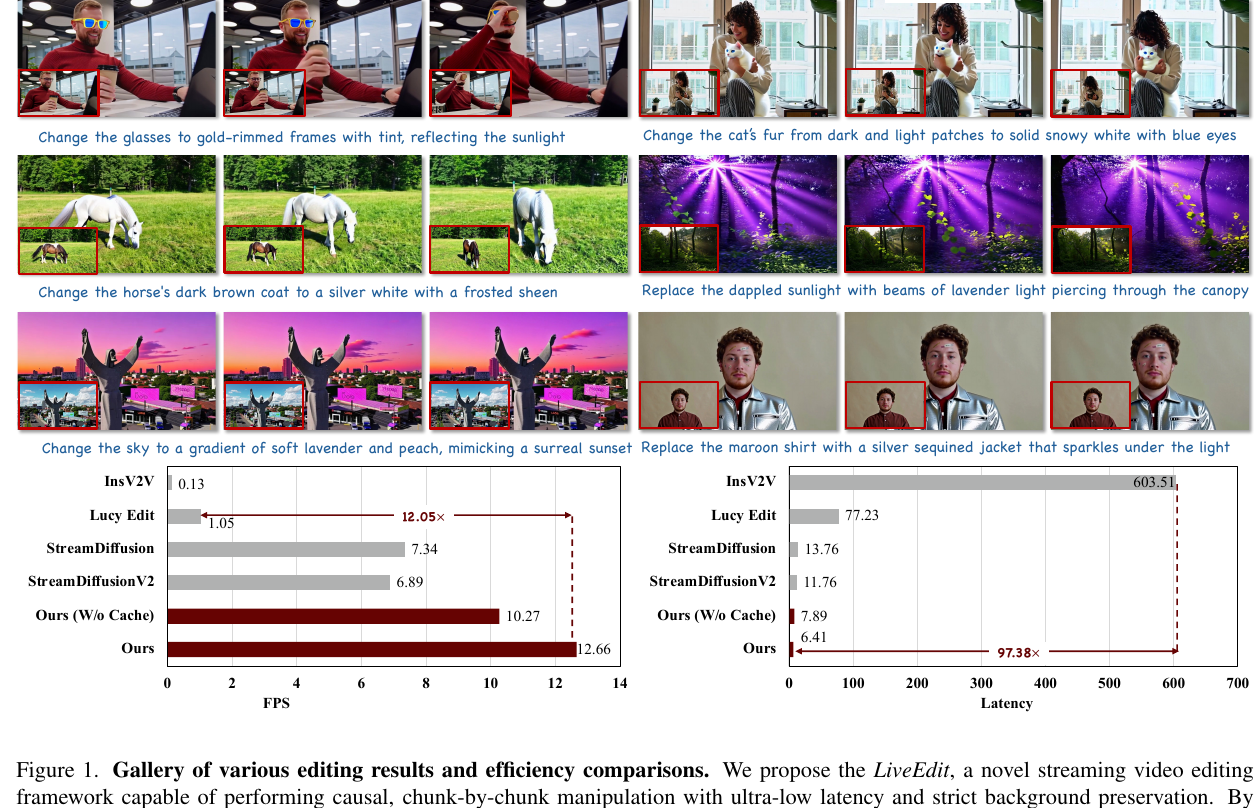
一页概览
本节导读:先建立论文全局地图:它要把离线 Diffusion 视频编辑推进到低 latency 的 streaming editing。
论文要解决什么
让 Diffusion video editing 从离线整段处理走向实时 streaming:模型只能看到当前和过去 chunk,不能依赖未来帧,同时还要保持背景稳定和局部编辑准确。
核心方案
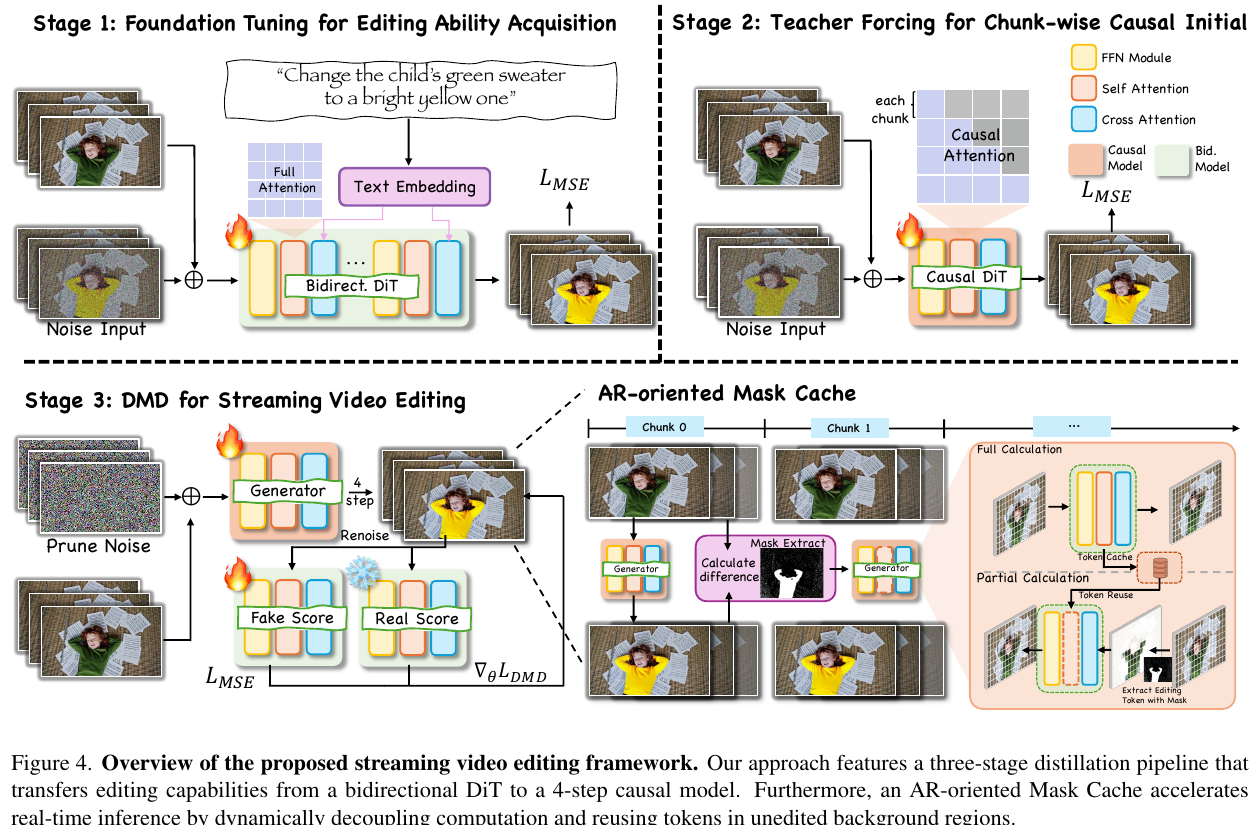
LiveEdit 用 three-stage distillation 把 bidirectional DiT 迁移成 causal DiT,再用 AR-oriented Mask Cache 复用未编辑区域 token,减少每帧冗余计算。
关键矛盾
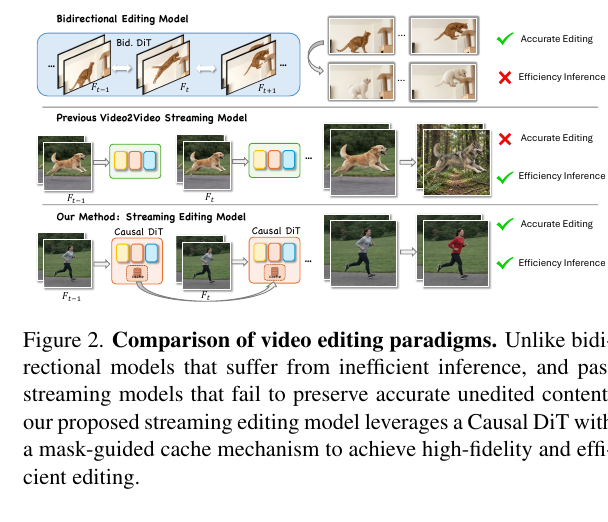
Bidirectional editing 准但慢,旧 streaming 方法快但不够准;LiveEdit 试图同时满足 accurate editing 与 efficient inference。
最该关注
看 Fig. 2 理解范式差异,Fig. 4 理解整体训练/推理流程,再用 Table 1-3 判断速度、质量和 cache 位置是否支撑结论。
Section
摘要与定位
本节导读:摘要说明 LiveEdit 的任务设定、三阶段蒸馏、Mask Cache 和 12.66 FPS 结果。
摘要译文
Streaming video editing 发展迅速,但实际部署仍受两个核心问题限制:一是需要在长时间序列中保持背景和未编辑区域稳定;二是需要满足实时交互场景所要求的低 latency。与此同时,近期 streaming video generation 方法大多面向 synthesis 任务,不能直接用于 editing,因为 editing 对内容保留和区域级控制有严格要求。
本文提出 LiveEdit,一个新的 streaming video editing framework,能够以 causal、frame-by-frame 的方式进行编辑,同时保持强内容保真和实时响应。其关键设计是一条 three-stage distillation pipeline,将强大的 bidirectional foundation model 的编辑能力逐步迁移到高效的 unidirectional streaming editor,从而在不牺牲视觉保真度的前提下实现稳定的长时程编辑。
为进一步支持实时部署,论文提出 AR-oriented Mask Cache,在帧间复用与区域相关的计算,显著减少冗余处理并加速推理。作者还建立了专门的 streaming video editing benchmark。实验表明,LiveEdit 在 streaming baselines 中取得 state-of-the-art 视觉质量,同时将推理速度提升到 12.66 FPS,适用于交互式和 augmented reality 应用。
Section
1 Introduction
本节导读:引言提出两个瓶颈:attention distribution shift 和 spatial-temporal token redundancy。
1 Introduction
视频编辑随着高质量内容创作和交互式数字体验的需求增长而快速发展。随着 augmented reality 和 live-streaming 应用更加普及,行业焦点正在从传统离线批处理转向实时、响应式编辑。但在 streaming 范式中,视频必须按 chunk 处理,且不能访问未来信息,因此低 latency 部署仍然很困难。
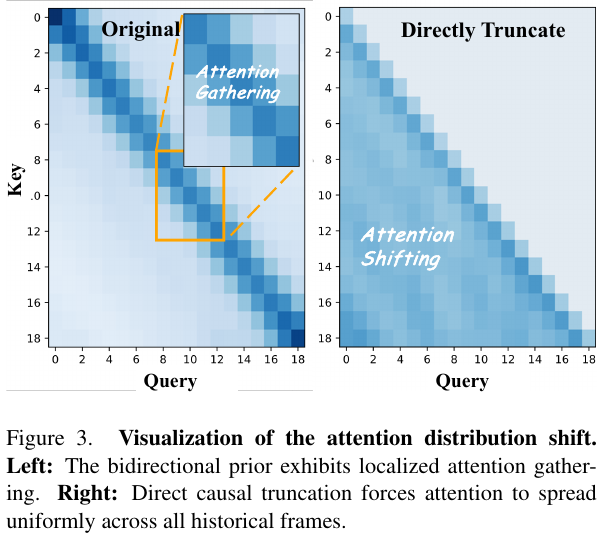
论文指出,实际 streaming video editing 面临两个瓶颈。第一是 attention distribution shift:state-of-the-art video diffusion models 通常依赖 bidirectional 或 global attention 维持时序一致性;直接截断未来 keys/values 会让注意力分布变平,导致遗忘效应、闪烁和结构不稳定。第二是 spatial-temporal token redundancy:标准 Diffusion pipeline 会把每帧当成独立的重生成任务,在未编辑背景上重复执行昂贵的 FFN 和 Attention,导致每帧 latency 过高。
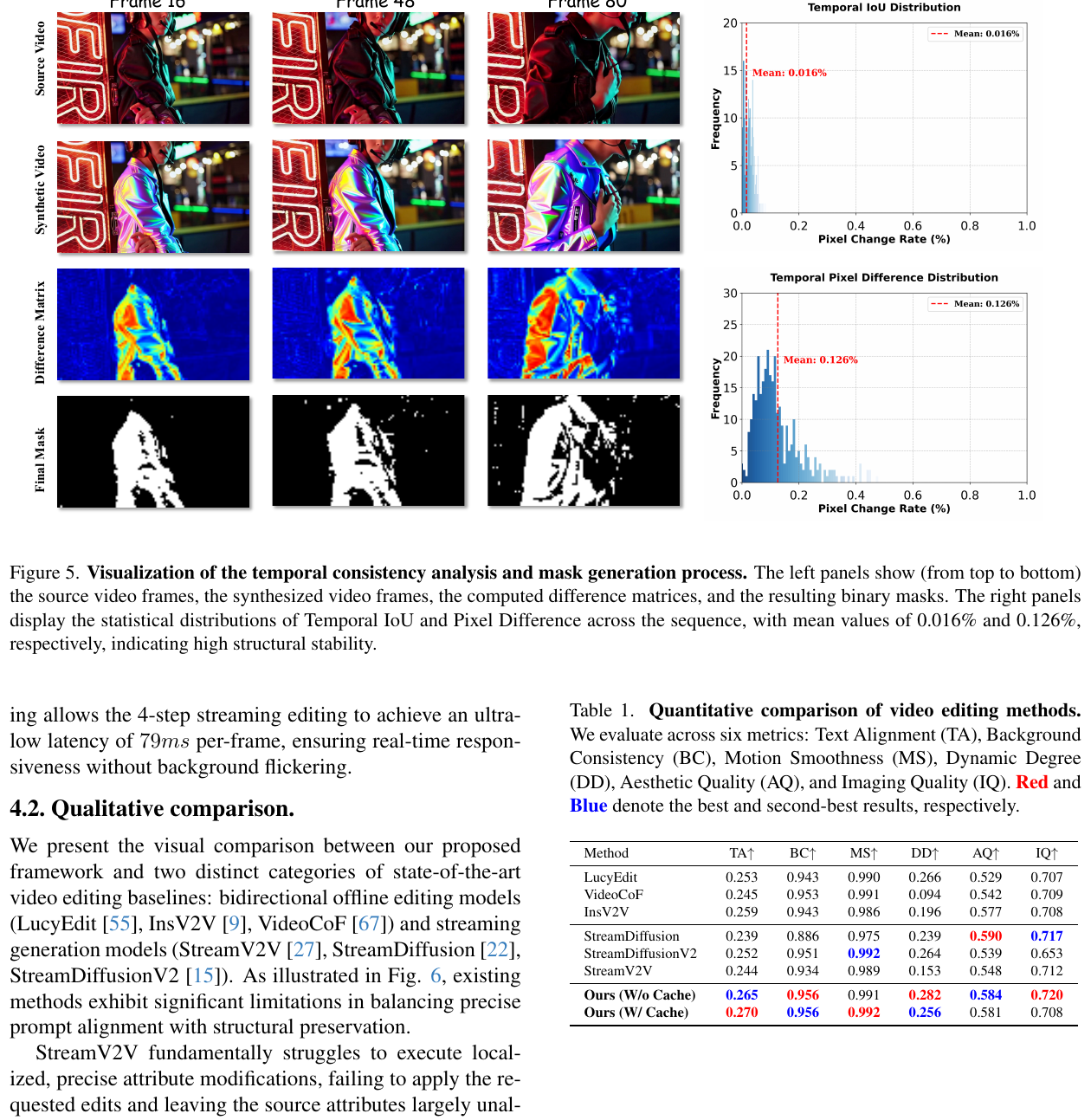
LiveEdit 用结构化 three-stage distillation pipeline 转移 bidirectional foundation model 的编辑能力,并在推理阶段引入 AR-oriented Mask Cache。该 cache 不对每帧所有 token 都运行完整 DiT,而是用 source 与 edited output 的 L2 distance 提取 editing mask,仅让活跃编辑区域做完整计算,对静态未编辑区域复用 Token Cache。
贡献可以概括为三点:提出 causal chunk-by-chunk streaming video editing framework;设计从 Bidirectional DiT 到 4-step Causal DiT 的 three-stage distillation pipeline,并提出基于 L2 distance 动态解耦计算的 AR-oriented Mask Cache;建立 streaming video editing benchmark,并在视觉质量、时序一致性和吞吐上达到 SOTA。
Section
3 Method
本节导读:方法部分是重点:three-stage distillation 解决架构不兼容,Mask Cache 解决计算冗余。
3.1 Motivation
离线 video editing 模型通过 dense temporal attention 将结构信息传播到过去与未来 token。若为了 streaming 直接砍掉未来上下文,attention weights 会被迫在所有历史帧上均匀展开,导致 pre-trained structural priors 被破坏。因此,论文用 progressive distillation 让 causal attention distribution 显式对齐 localized bidirectional prior。
另一方面,streaming generation 方法通常为每个 incoming frame 对所有 spatial tokens 做 dense computation,但 editing 不同于 global translation:未编辑区域 token 的中间特征必须保持绝对时序一致。对这些区域重复全量生成不仅浪费计算,还会破坏背景稳定性。
3.2 Three-Stage Distillation Pipeline
Stage 1 Foundation Tuning:建立 Bidirectional DiT editing baseline。输入是 original video latent 与 noisy latent 的 channel-wise concatenation,模型通过标准 noise-matching objective 学习复杂编辑映射。
Stage 2 Teacher Forcing:引入 chunk-wise causal attention mask Mcausal,把 bidirectional DiT 迁移到 autoregressive 输入输出。Teacher Forcing 让 causal model 的输出分布对齐 Stage 1 学到的 bidirectional representation,避免没有未来 token 时出现结构塌陷。
Stage 3 DMD:为了超低 latency,使用 Distribution Matching Distillation 将采样压缩到 4 steps。DMD gradient 在 frozen Real Score model 与 trainable Fake Score model 之间计算,直接从 Stage 2 权重初始化 generator,绕开昂贵的 ODE initialization。
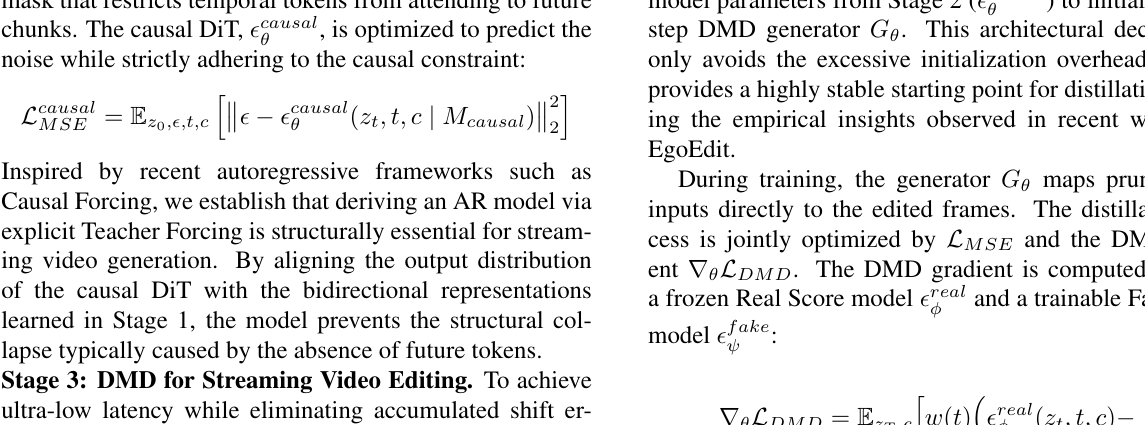
公式解释:Stage 1/2 的 LMSE 约束模型预测噪声与真实噪声一致,用于保持编辑质量和 causal 一致性;DMD 公式约束 student generator 的分布匹配 real score,减少少步推理带来的分布偏移与连续 streaming 中的累计 shift。
3.3 AR-oriented Mask Cache
推理时,pipeline 以 sequential chunks 处理视频。对 incoming chunk k,方法从前一 chunk 的 source latent 和 edited output latent 计算 L2 distance,提取 binary spatial editing mask Mk。mask 为 1 的空间 token 是活跃编辑区域,执行完整 Self-Attention、Cross-Attention 和 FFN;mask 为 0 的未编辑区域直接从 Token Cache 取回上一 chunk 的特征。
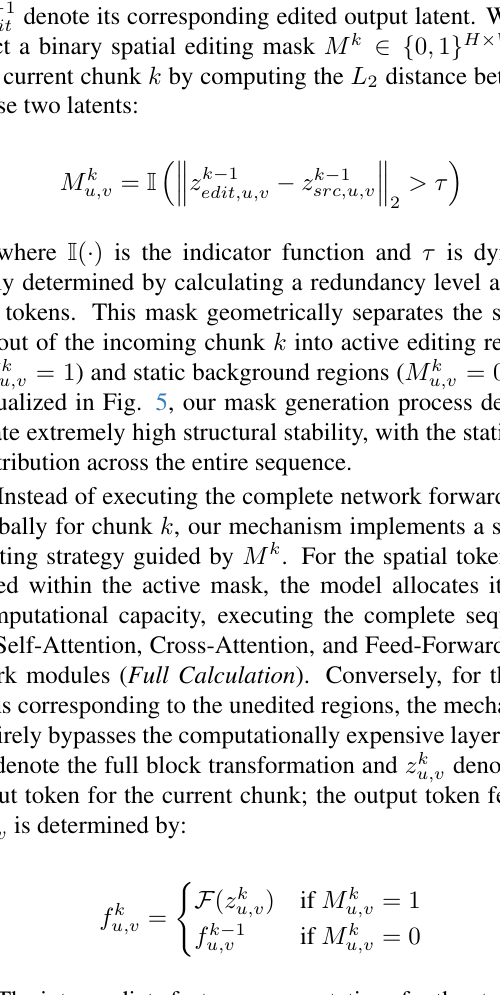
公式解释:第一个公式用动态阈值 τ 判断 source 与 edited latent 的 L2 差异是否足够大,从而产生 editing mask。第二个公式定义 token routing:编辑区域使用 full block transformation F,静态区域复用上一 chunk 特征。它减少的错误包括背景闪烁、未编辑区域漂移和全局重算带来的结构破坏。
Section
4 Experiment
本节导读:实验部分验证 LiveEdit 在视觉质量、文本对齐、背景一致性和速度上的平衡。
4.1 Implementation Details
模型基于 Wan2.1-T2V-1.3B 构建。Stage 1 采用 channel-wise concatenation 整合 noisy latent 和 condition latent,训练数据包含从 Ditto-1M 过滤出的 20K 高质量 video pairs。三阶段 distillation 在 8 张 NVIDIA A100 GPU 上逐步训练,优化器为 AdamW。
Stage 1 训练 bidirectional foundation model 9K steps;Stage 2 通过 chunk-wise causal attention mask 继续 fine-tune 20K steps,temporal chunk size 为 3 latent frames;Stage 3 初始化 4-step generator,并以 [0, 250, 500, 750] 作为 sampling timesteps,训练 10K steps。推理时模型每 step 解码 3 frames,Mask Cache 动态剪掉约 70% 冗余 spatial tokens。
4.2 Qualitative Comparison
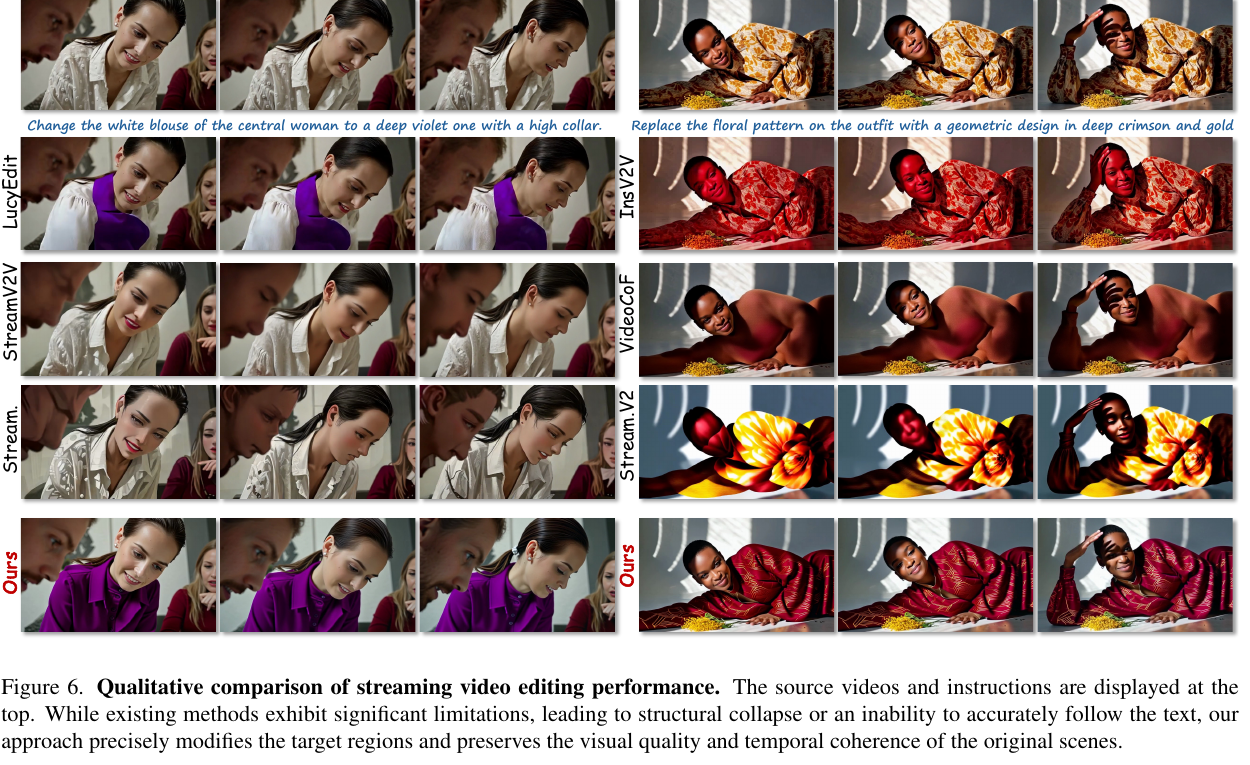
论文与 LucyEdit、InsV2V、VideoCoF、StreamV2V、StreamDiffusion、StreamDiffusionV2 等 baseline 对比。现有方法在 prompt alignment 与 structural preservation 之间很难平衡:StreamV2V 难以执行局部属性修改;InsV2V 和 VideoCoF 容易把目标属性扩散到整帧;StreamDiffusion 系列会出现结构塌陷或非预期风格漂移。LiveEdit 由于显式解耦编辑区域和未编辑区域,更能保持局部纹理、背景和主体身份。
4.3 Quantitative Comparison
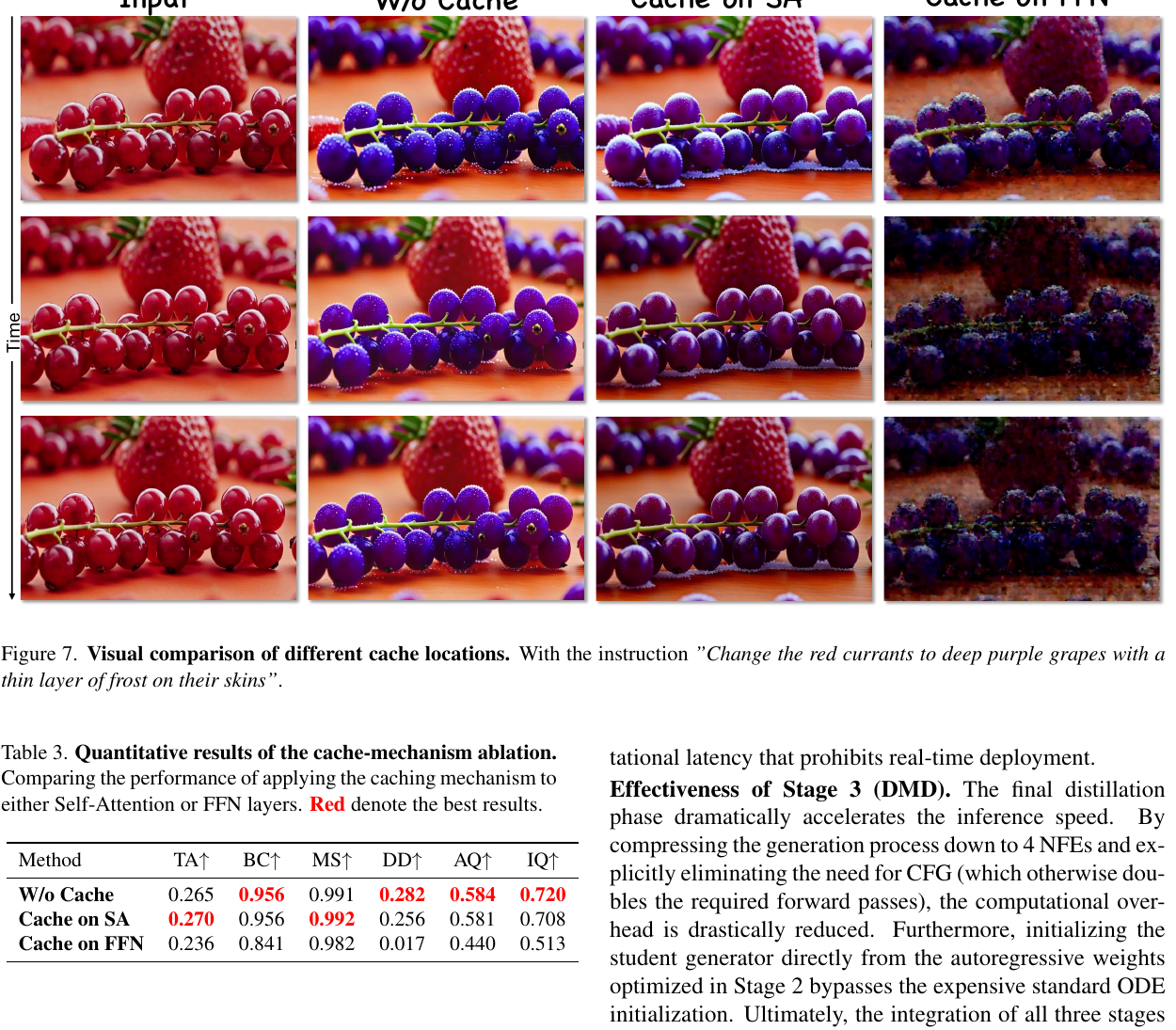
主实验 benchmark 包含 120 pairs,使用六个自动指标:Text Alignment (TA)、Background Consistency (BC)、Motion Smoothness (MS)、Dynamic Degree (DD)、Aesthetic Quality (AQ)、Imaging Quality (IQ)。LiveEdit 在多数维度上取得最佳或接近最佳表现。尤其是 Ours (W/ Cache) 达到 TA 0.270、BC 0.956、MS 0.992;无 cache 版本在 DD、AQ、IQ 上更强,但 cache 版本进一步降低 latency 并保持主质量指标。
Section
4.4 Ablation Study
本节导读:消融解释三阶段训练各自的必要性,以及 cache 放在 Self-Attention 的原因。
4.4 Ablation Study
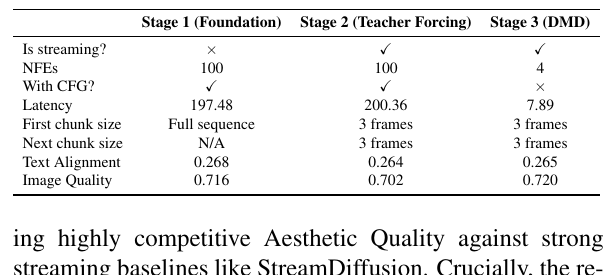
Stage 1:建立强 bidirectional prior,是高保真结构保留和文本对齐的基础,但需要 100 NFEs 和 CFG,无法 continuous streaming。
Stage 2:引入 chunk-wise causal attention,让模型能按 3-frame chunks 进行 autoregressive execution;但仍保留 100 NFEs 和 CFG dependency,因此计算 latency 仍然太高。
Stage 3:DMD 将生成压缩到 4 NFEs,并去掉 CFG 需求,最终达到 81 frames 仅 7.89s 的 latency,提供纯 streaming 功能与高质量编辑。
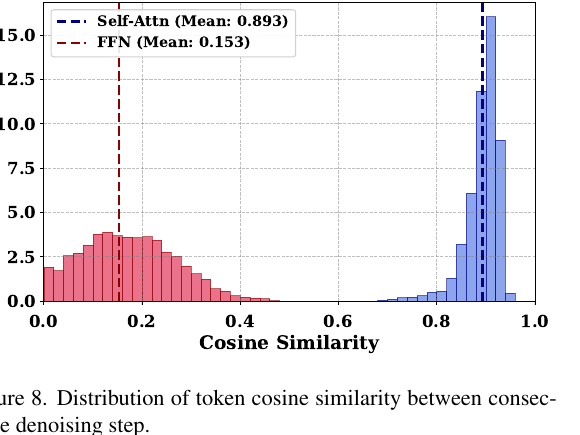
AR-oriented Mask Cache:将 cache 放在 Self-Attention 层最优,因为 SA tokens 在连续 denoising step 中冗余高;FFN 负责高频空间细节,直接复用会导致模糊和结构不稳定。
Section
5 Conclusion
本节导读:结论总结 LiveEdit 的实时性贡献,并补充部署与评估上的阅读提醒。
5 Conclusion
论文提出 LiveEdit,一个新的 streaming video editing framework,成功把强 bidirectional diffusion priors 适配到高效的 unidirectional autoregressive paradigm。为克服 causal execution 中固有的 attention distribution shift,作者提出包含 Foundation Tuning、Teacher Forcing 和 DMD 的 progressive three-stage distillation pipeline,将离线全局处理和在线连续视频编辑连接起来,并把推理过程压缩到 4 steps。
同时,LiveEdit 通过 AR-oriented Mask Cache 缓解 spatial-temporal token redundancy,减少计算开销,并严格保证未编辑区域零视觉退化。大量定量与定性实验表明,该框架在 text alignment、结构保留和 ultra-low latency 之间取得独特平衡,为实际实时 streaming video editing 应用铺路。
局限与批判性阅读
LiveEdit 的优势建立在特定 streaming benchmark、Wan2.1-T2V-1.3B foundation model 和 20K filtered pairs 上。12.66 FPS 与 79 ms latency 很有吸引力,但部署到不同分辨率、设备和更复杂 AR 场景时仍需重新验证。Mask Cache 依赖 source/edit latent 差异生成区域 mask,若编辑目标包含大范围光照、反射或非刚体结构变化,mask 的保守性和误检会影响质量。
Section
Supplementary
本节导读:补充材料提供用户研究和更多案例,这里保留其主要结论与阅读路径。
补充材料内容
补充材料包括与先前方法的讨论、用户研究、更多 LiveEdit 生成案例,以及更多 baseline 对比。用户研究让 20 名志愿者从 instruction consistency、background consistency 和 visual quality 等维度排序,结果支持 LiveEdit 在语义编辑和背景保留之间的平衡。
阅读路径
建议先读 Fig. 1 和 Fig. 2 把握动机,再读 Sec. 3.2/3.3 理解 distillation 与 mask cache,最后用 Table 1-3 和 Fig. 7/8 检查实验是否支持“cache 放在 Self-Attention、DMD 负责速度”的核心结论。
Section
参考文献
本节导读:保留英文引用条目索引,完整列表仍以原论文 PDF 为准。
参考文献
参考文献保留原英文条目形式。完整 bibliography 见论文 PDF 第 13-16 页;HTML 中列出与本文方法和实验直接相关的核心引用。
- Ditto: high-quality synthetic dataset for instruction-based video editing.
- VACE: All-in-one video creation and editing.
- InsV2V: Consistent video-to-video transfer using synthetic dataset.
- Lucy Edit: Open-weight text-guided video editing.
- StreamDiffusion: A pipeline-level solution for real-time interactive generation.
- StreamV2V: Streaming video-to-video translation with feature banks.
- StreamDiffusionV2: sink-token-guided rolling KV caches for ultra-low-latency live generation.
- EgoEdit: dataset, real-time streaming model, and benchmark for egocentric video editing.
- DeepCache and VMem: cache methods for efficient diffusion/video generation.
- Distribution Matching Distillation and Improved Distribution Matching Distillation.
- FlashVSR: real-time diffusion-based streaming video super-resolution.
- Wan: open and advanced large-scale video generative models.
- VBench: comprehensive benchmark suite for video generative models.
- CLIP: learning transferable visual models from natural language supervision.